What Is Physics? The Five Ws of the Universe
Lesson 1 · May 29, 2026
What Is Physics? The Five Ws of the Universe
A first-principles opening lesson: physics as the answer to the five Ws — where, when, what, why, and who — followed by our first concrete tool, the velocity–time graph.
Overview
This opening lesson frames the whole subject before a single formula appears. Physics, we argue, is the project of answering the five Ws of the universe: where and when things happen (space and time, which turn out to be one thing — spacetime), what exists (matter, field, and information), why it behaves as it does (everything is in motion, governed by exactly four forces), and who is asking (the observer, who in modern physics cannot be removed from the picture). The second half becomes concrete: we read velocity–time graphs, discover why the area under the curve is the distance travelled, and set up a free-fall problem.
Topics Covered
- The five Ws as a map of physics: where · when · what · why · who
- Space and time are coupled into one 4-(or 11-)dimensional canvas: spacetime
- Why everyday 3D space may hide extra dimensions (the 10-/11-D idea)
- The three ingredients of reality: matter, field, and information
- Existence is motion: relative motion, microscopic (thermal) motion, and why nothing is ever truly at rest
- The cosmic microwave background: empty space still sits at ~2.7 K
- The four fundamental forces: strong, weak, electromagnetic, gravity
- Kinematics: velocity–time graphs and area = distance (\(s=\int v\,dt\))
- A free-fall problem: a ball falling past two windows 3 m apart
Key frames from the lecture
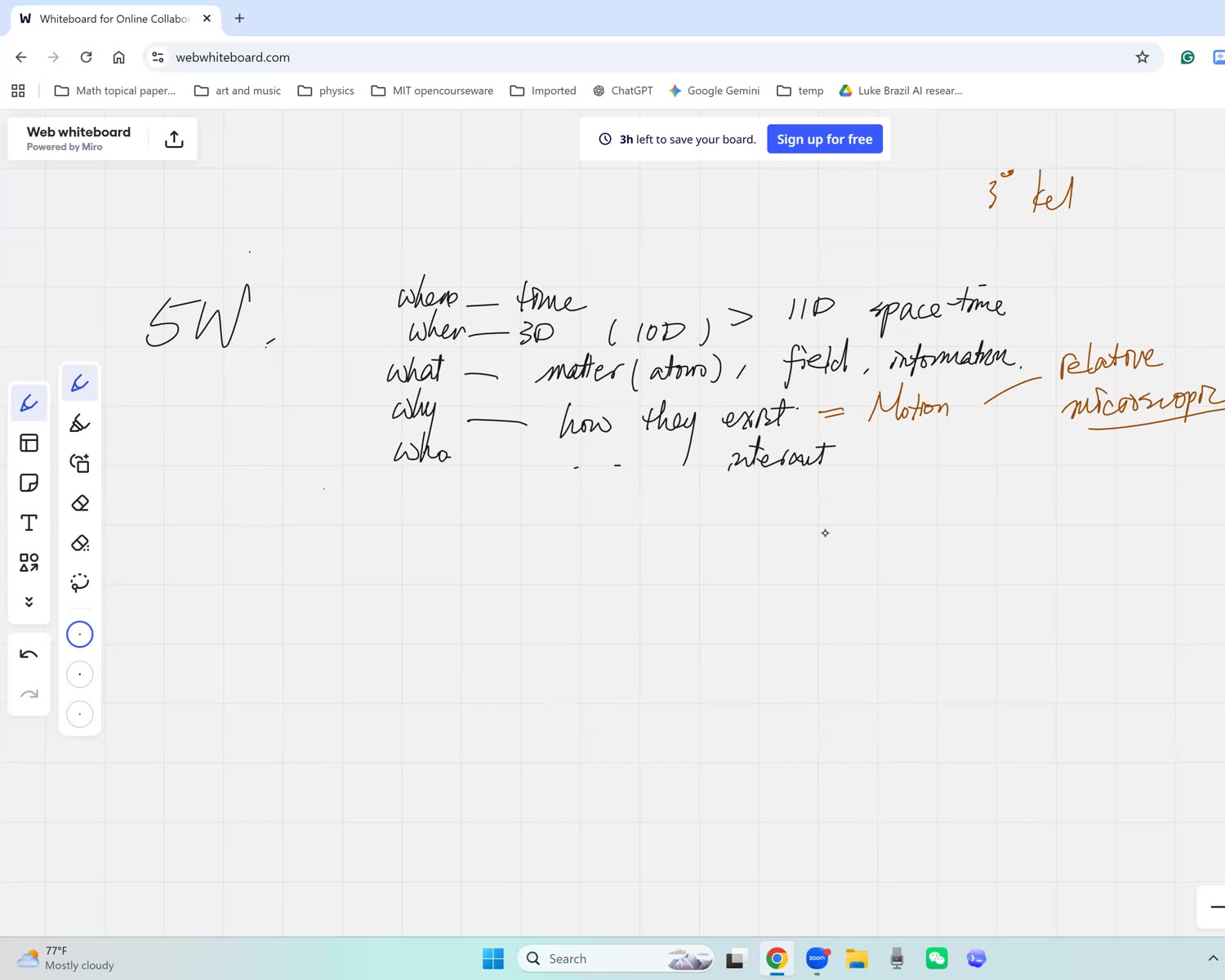
The board midway through: the five Ws expanded into space·time → 11-D spacetime, matter·field·information, and "how they exist = Motion."
Most courses open with formulas. This one opens with a map, because a beginner who knows what physics is trying to do can place every later formula on that map. The five Ws are that map: every topic this year — kinematics, forces, energy, fields, relativity — is an answer to where, when, what, why, or who.
The Five Ws
Physics answers five questions about the universe. We refuse the old idea that science is a “straight-faced, objective” enterprise with no room for the observer — modern physics (quantum mechanics) puts the who back at the centre.
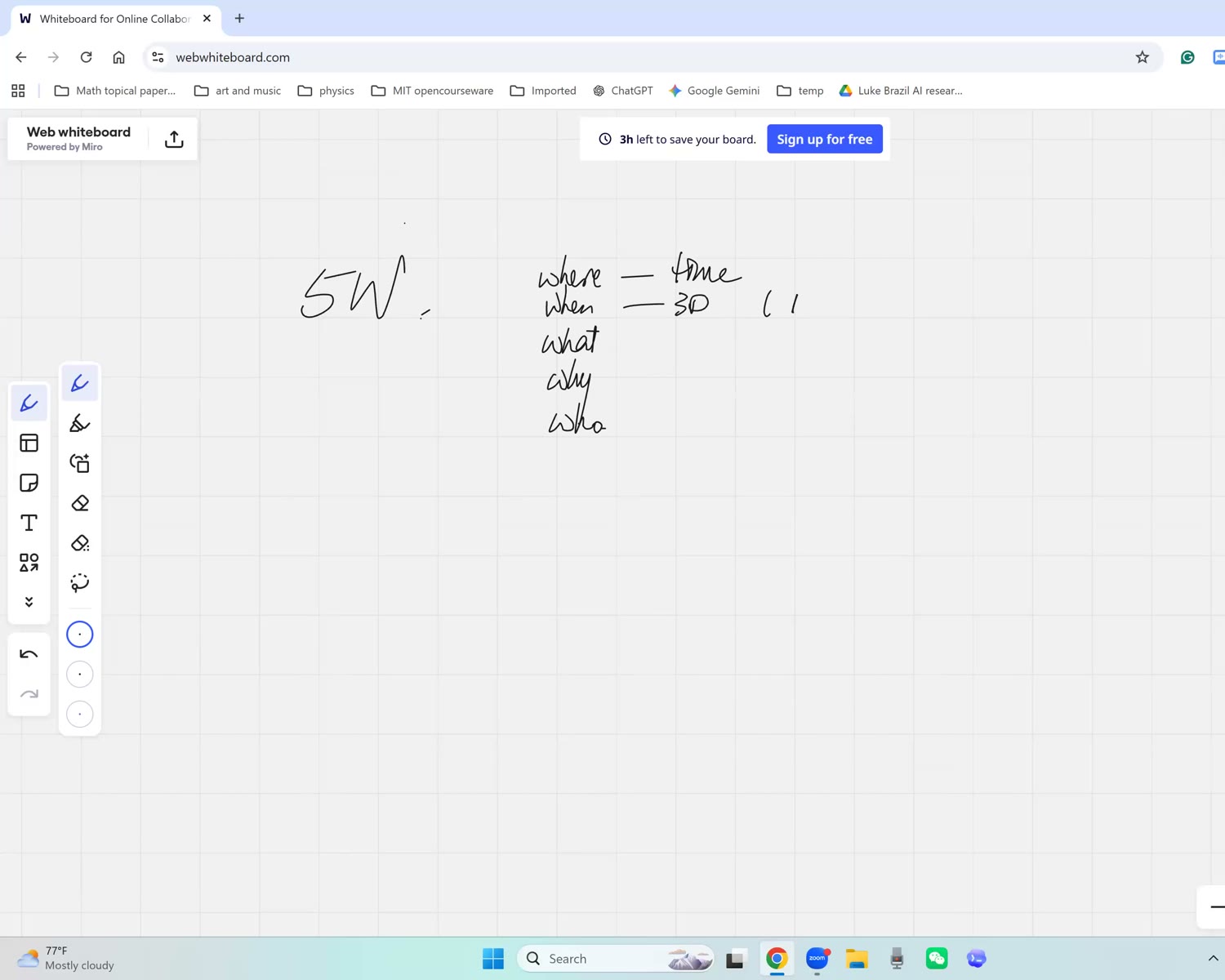
Where · when · what · why · who — the scaffold for the whole subject.
| W | Question | Physics answer |
|---|---|---|
| Where | the stage | 3-D space (and maybe more) |
| When | the timing | time — fused with space into spacetime |
| What | the cast | matter · field · information |
| Why | the plot | motion, governed by four forces |
| Who | the audience | the observer (essential in quantum mechanics) |
Where & When: from space to spacetime
We live, day to day, in three-dimensional space: three numbers locate any point. Time is a fourth number — when. The deep lesson of relativity is that you cannot speak of one without the other: space and time are coupled into a single object, spacetime. “Spacetime” is one word on purpose.
A useful picture: put two space directions on the floor and let time run vertically. Then a particle is no longer a moving dot — its entire history is a single static curve rising through spacetime, called a worldline. Drag to orbit the scene below.
A point particle is a dot in space but a curve in spacetime. That curve — its worldline — contains the whole history of the particle at once. Relativity treats motion not as “a dot that moves” but as “a fixed shape in spacetime,” which is why time and space have to be measured together.
Going deeper. Two short, beautiful explainers on why space and time fuse:
What’s out there: matter, field, information
The “what” of the universe has three ingredients, discovered in this historical order:
- Matter — anything with mass, built from atoms (“divide, divide, divide… until you can’t”). Known since antiquity (~600 BC onward).
- Field — something real and energy-carrying that has no mass, so it is not matter, yet it pushes matter around: the electromagnetic field, the gravitational field. A field is “filled with energy; it can exert force.” Recognised only ~1700s onward — electricity is the field made useful.
- Information — in the last ~50–60 years (Hawking and black-hole physics), information became a physical quantity: it can be quantified, it carries energy, and it even sets the entropy of a black hole through its event-horizon area.
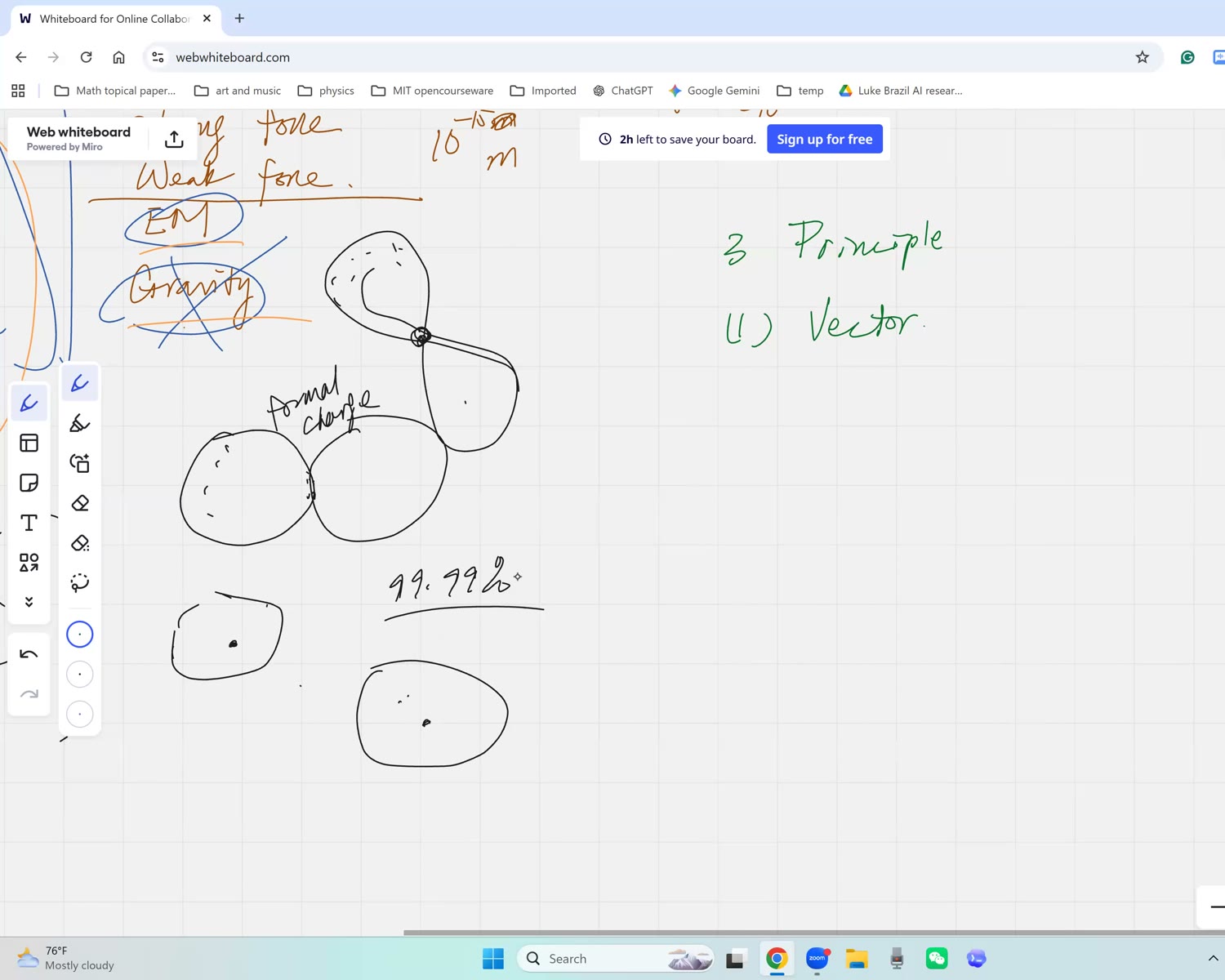
Matter divides down to atoms — themselves almost entirely empty space: a ~10⁻¹⁵ m nucleus inside a ~10⁻¹⁰ m atom (≈99.99% void).
A field has no mass yet is perfectly real — flip a switch and light fills the room instantly. And information is not a metaphor for “knowledge”; it is a measurable physical quantity. Matter, field, and information together are what physics is about.
Everything exists in motion
Here is the lesson’s most radical sentence: to exist is to be in motion. Try to find a counterexample and it slips away:
- Relative motion — your laptop sits still relative to you, but you, the Earth, and the Sun are all hurtling through the galaxy. Rest is always rest relative to some frame.
- Microscopic (thermal) motion — even a “still” object is a storm of jiggling molecules. That jiggling is temperature; it is the object’s internal energy.
- Rotation, light, smell — a spinning top’s centre stays put while its parts move; you see an object only because photons stream off it; you smell tea only because vaporised molecules drift to your nose. Perceiving anything already implies motion.
The box below is a gas of molecules. Raise the temperature and they jiggle faster; lower it toward zero and they slow — but never stop completely.
Going deeper. Brownian motion — the visible jitter that first proved atoms are real and never still:
Nothing reaches absolute zero
If motion never fully stops, is there anywhere truly at rest? No. Even the emptiest interstellar space is bathed in the cosmic microwave background — a faint glow left over from the Big Bang, sitting at about 2.7 K, not 0 K.
\(0\ \text{K} = -273.15\,^\circ\text{C}\) is the temperature at which microscopic motion would be minimal — but the universe never gets there. After ~14 billion years of cooling, deep space still measures ≈ 2.7 K. There is always some motion, somewhere.
The four fundamental forces
If existence is motion, the next question is why things move as they do — and the answer is interaction, which we call force. Remarkably, every interaction in the universe is one of just four forces. (The names “strong” and “weak” are proper names, not descriptions — even the “weak” force is strong on its own scale.)
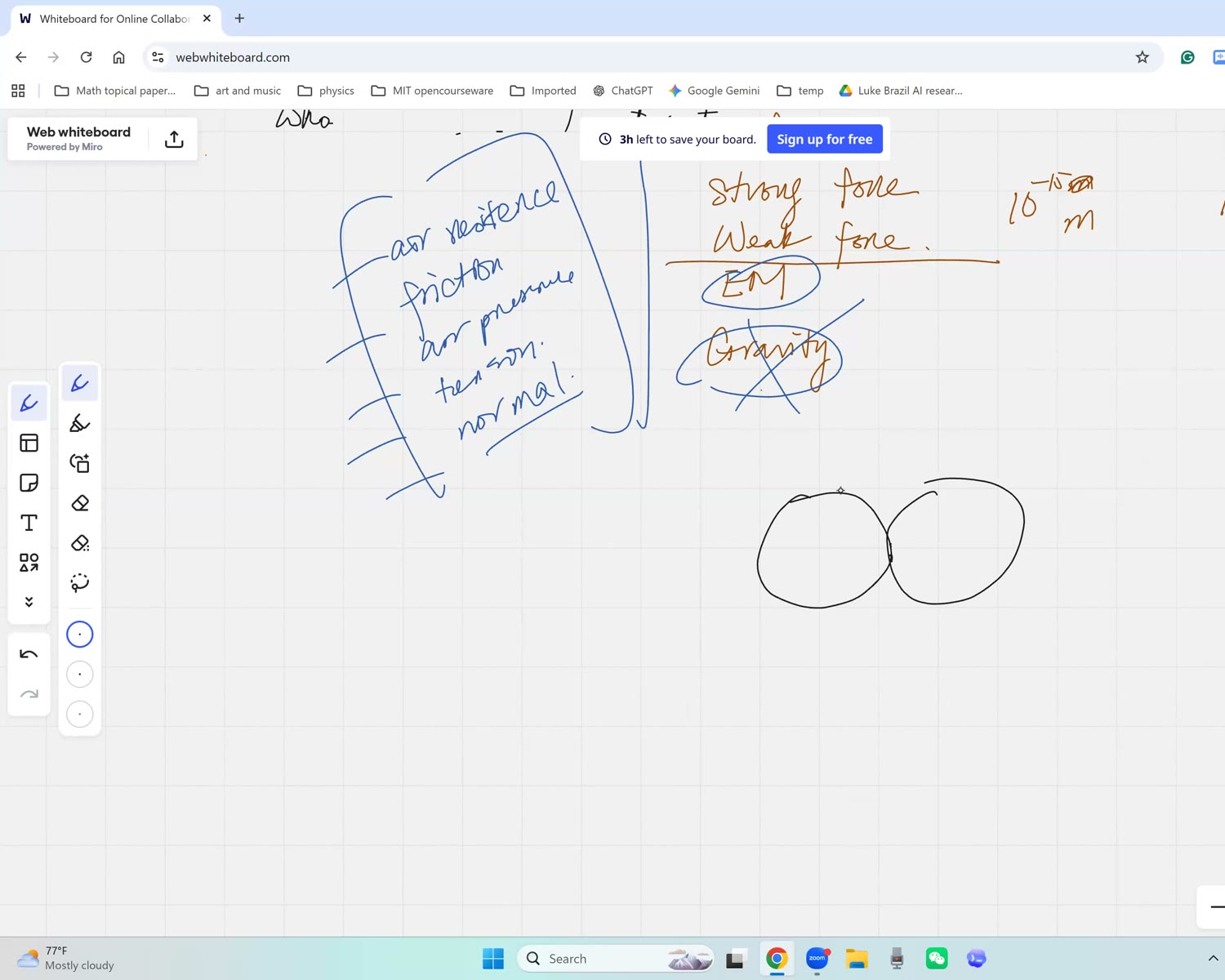
Right: the four fundamental forces. Left: the everyday forces (friction, air resistance, tension, normal) are all electromagnetic in disguise.
| Force | Binds / does | Range | Relative strength |
|---|---|---|---|
| Strong | holds protons & neutrons in the nucleus | ~\(10^{-15}\) m | \(1\) |
| Weak | radioactive (beta) decay: neutron → proton | ~\(10^{-18}\) m | \(\sim 10^{-6}\) |
| Electromagnetic | binds atoms; all everyday forces (friction, tension, normal, air resistance) | infinite | \(\sim 10^{-2}\) |
| Gravity | attracts all mass-energy; shapes the cosmos | infinite | \(\sim 10^{-39}\) |
Gravity is by far the weakest and the only one not yet unified with the others.
The scene below is an atom: a nucleus of protons (red) and neutrons (grey) held together by the strong force, with electrons bound in orbits by the electromagnetic force. Pick a force to see what it governs.
Going deeper. Two overviews of the four forces — Michio Kaku’s short take, and a fuller walkthrough:
Kinematics: velocity–time graphs and area = distance
Now the lesson turns concrete. Plot velocity on the vertical axis and time on the horizontal axis. The key result — and the bridge to calculus — is:
\[ s = \int_{t_0}^{t_1} v(t)\,dt = \text{area under the velocity–time curve.} \]
For a straight-line (constant-acceleration) graph this area is just a triangle or trapezoid: with average velocity \(\dfrac{v_0+v_f}{2}\) over a time \(\Delta t\), \[ s = \frac{v_0+v_f}{2}\,\Delta t. \]
In the class problem, two balls A and B move so that A speeds up (its v–t line rises) while B slows down (its line falls). The distance each travels is the area under its own line — and comparing those triangular areas is how we find where and when they meet.
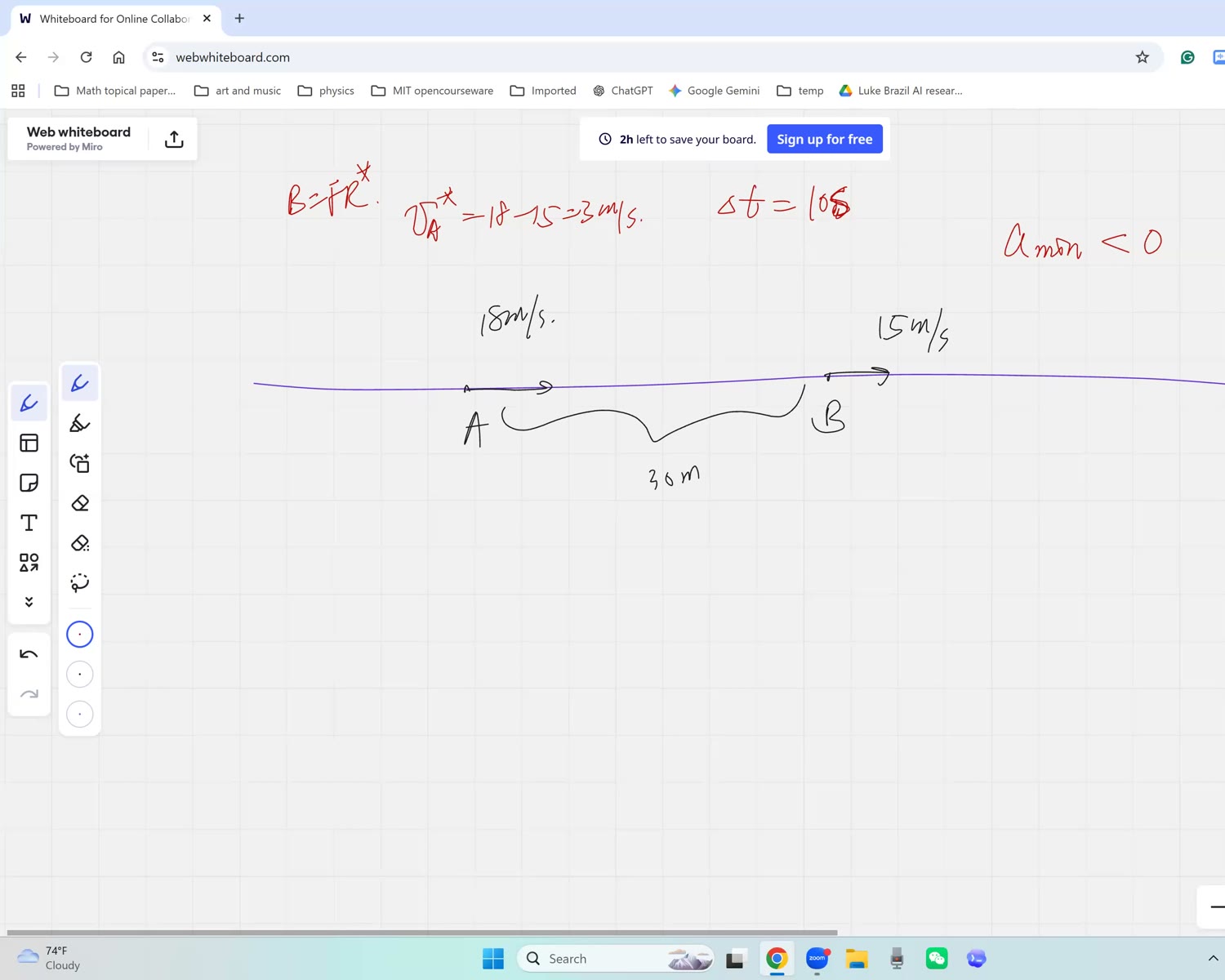
The setup on the board: balls A and B, 30 m apart, with velocities 18 m/s and 15 m/s.
Drag the sliders: each shaded triangle is the distance that ball travels; watch where the areas balance.
Going deeper. Khan Academy on exactly why that area is the distance:
Free fall: the two-window problem (homework)
Finally, a problem to take home. A ball is dropped from rest. Far below, two windows are 3 m apart, and the ball is seen to fall from the top window to the bottom one in Δt = 0.2 s. Taking \(g \approx 10\ \text{m/s}^2\), from what height above the top window was it released?
Two windows are 3 m apart. A ball in free fall (from rest, \(g=10\ \text{m/s}^2\)) takes 0.2 s to pass from the upper window to the lower one. Find the release height above the upper window.
Hints. Free fall from rest gives velocity \(v = g t\) and drop \(h = \tfrac{1}{2} g t^2\). Let the ball reach the upper window at time \(t_1\); then it reaches the lower one at \(t_1 + 0.2\). The extra 3 m is \(\tfrac12 g (t_1+0.2)^2 - \tfrac12 g t_1^2 = 3\). Solve for \(t_1\), then the release height is \(\tfrac12 g t_1^2\).
The animation drops a ball past two windows 3 m apart. Watch the velocity arrow grow (it never falls at constant speed — gravity keeps accelerating it) and read the time between windows.
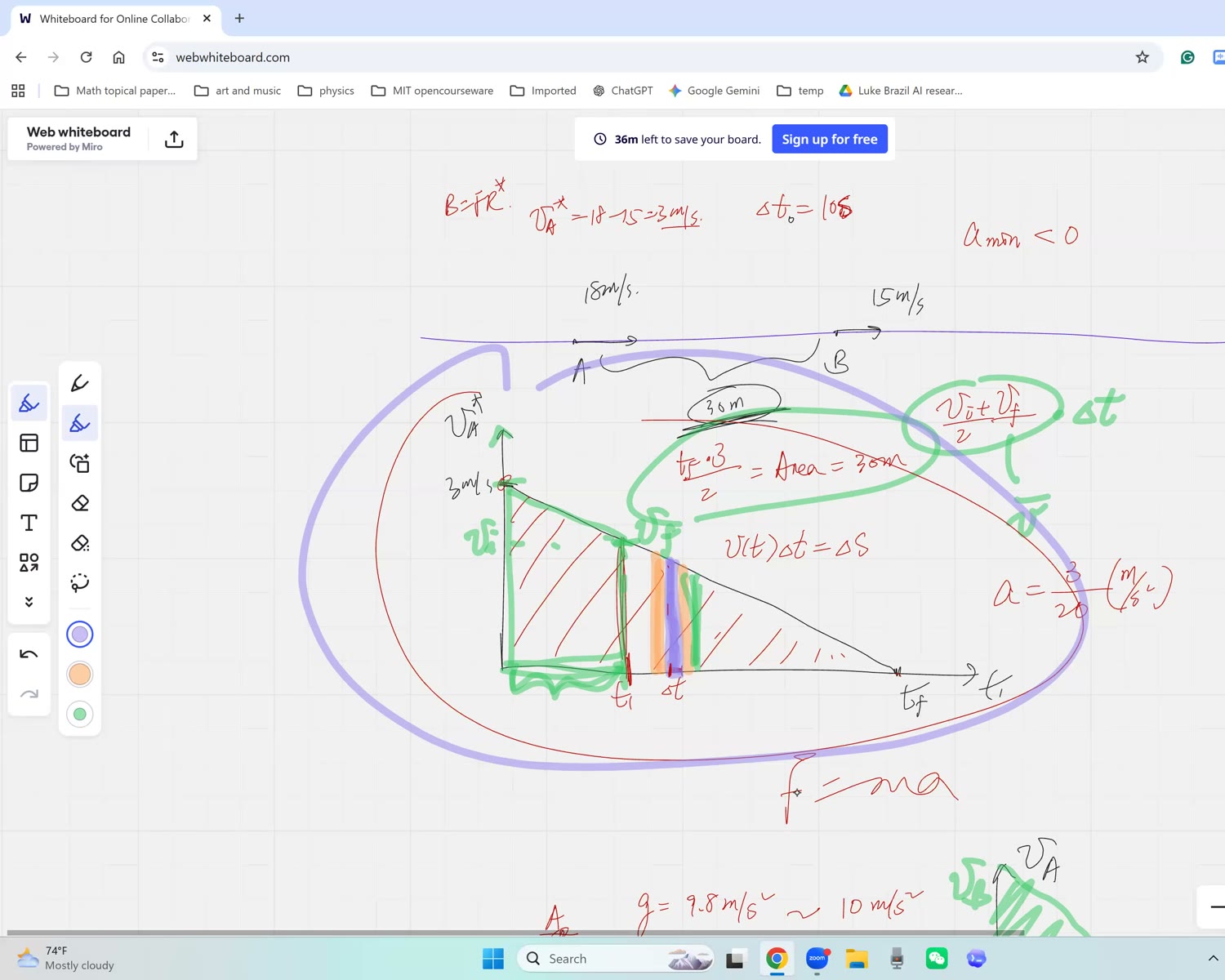
The synthesis on the board: average velocity (v₀+v_f)/2, area = distance, V(t)·δt = δs, and f = ma waiting in the wings.
Going deeper — the full playlist
A few more hand-picked explainers for the ideas this lesson touched:
- Spacetime diagrams — MinutePhysics: Special Relativity Ch. 2
- Extra dimensions — Ask a Spaceman: How do extra dimensions work?
- Brownian / thermal motion — Brownian Motion: the physics of randomness
- Four forces (longer) — The Four Fundamental Forces of Physics
- Chinese explainers (B站) — 李永乐老师’s channel has excellent talks on relativity, forces, and dimensions.
Generated transcript
This transcript was generated locally with qwen3-asr and has not been manually corrected. Names of students have been spoken aloud in class; treat the transcript as an informal record.
Open generated transcript (18,140 words)
Thank you. Also, I would be happy if you guys figure out how to compose your textbook using AI. Then you don't need to worry about not fully recovering the content we cover in class. I'm still sort of chatting and waiting for people to come in.Let me clean the board. Do like Control A to select everything. Oh, really? Let me see. Control A. I don't know whether that works. Hold on. Let me try. Control A. Wow, wonderful! Thank you. Thank you.I learned. So A means all, apparently. You know? Do you guys know what Phoenix is about? Good to see Jacqueline. Hey, good to see you, Jacqueline. And usually, I begin by asking the kids to turn on your recording, and I'm asking you to do so because apparently you need you don't need my permission. You probably are using.iPad. All right, Catherine is yet to be here, but we're going to go forward. I as really a opening and what physics is about. Physics answers the five Ws of the universe. Basically, we do know there's when, and there's where. Let's get the stage, and let's get the time, and there's what, and there's how or why, and there's who, andWe don't want to think of physics as a straight-faced, objective science where instruments and apparatus speak. Human beings needed to relinquish our subjectivity. Therefore, there's no position for the "who" in scientific study. That's just not true. It's not true on the social level. It's not true on the intellectual level. It's not true on the methodological level, and it's not true in the most profound way that modern physics here necessitates the presence of the objective.That's quantum mechanics. So the who is a big deal here. It's not to be neglected. Okay, let's see where. Let's see the a canvas which we call time. Basically, everything happens in time. One in our cosmos, which we live in a three D space. However, as we deepen our understanding of physics, we shall find out what seems to be three D space is actually ten dimensions. So three D every day, but then hidden seven dimensions more. Basically.Ten D. When we actually discover all those mathematical nuances and the crannies and the quirks, but speaking of both where and when, we call that eleven dimensional spacetime, and it's not just taking on space with time now. Now, spatial temporal universe, spacetime is one word, meaning they're coupled together. In fact, you can't even speak of one without identifying the other. That's the fruit of relativity. This is a pro.Found statement. Okay, and I'm not expecting us to understand it right away. But in four years, we shall deeply appreciate why we speak of the space-time as the one single canvas upon which we're painting Phoenix. Good to see you, Eddie. I'm giving the preamble. This is introducing the the story we're in. Phoenix is about answering the five W questions of the universe. The where it's in time. Sorry, what? I think I wrote them backward. The where it's in three D.

Space and the one is in time, and which we call spacetime. And what what's out there in the universe? Well, starting from three millennia ago, people realized we can break down, conquer, discover the fundamental building blocks of what we call the material universe. Everything we see, so matter. Matter is made up of atoms. You can divide, divide, divide up to the point you can't divide anymore. But you see this.It's a profound idea we want to understand by analyzing, meaning dissecting, cutting it into small portions, as if learning the building blocks amounts to learning the whole. Well, it goes a long way. You do understand a lot about the whole, but not quite the same. Okay, there are actually holistic point of view where the sum of the parts is a lot greater than the parts. More on that. But the story doesn't stop at matter, and this is really just the atoms. In fact, there are still.Something real, tangible, carrying energy, affecting matter, deciding the evolution of the universe, filling the entire universe, but it doesn't have mass, meaning it doesn't count as matter, and that's field. But we do know, though, historically speaking, it took about the twenty-three centuries after the first development of physics, which was about the six hundred BC. But it was only around seven hundred that people had the theory about field, electromagnetic field, gravitational field, field.Field is filled with energy. It could exert force. It could interact and matter to matter, but it's not matter. So, second one on our list. It's also basically one of the things we shall study in physics. Now, does it stop? Is there something else that also contribute to the evolution of the universe, which also fills space, which also carries energy, which also interacts with matter and field? It was only in the past fifty or sixty years.Years, Stephen Hawking and the study of the black hole brought to our attention information. Information is not just abstract. I'm not giving you a metaphor and say knowledge is power. No, information itself can be quantized, can be quantified, and can be actually found out what is the energy, how does it propagate, and they align the so-called event horizon of the black hole. They even determine the size of the black hole and its entropy. So, in about two years, you.You shall understand. Information is such a vital part of what we call everyday material reality now, and you need to know this is a lot more tangible than what you usually speak of the word information, as if it just means knowledge, know something, data. No, it doesn't mean that. It has its own very specific physics content. Well, is there a fourth item? Not yet, but I have the feeling feeling that since actually there were spans of about two millennia between the.The discovery of matter and the discovery of the field, and again, there were four centuries between the discovery of the field and discovery of the information or formulation of the information as part of the material universe. I have the feeling that the list is not closed. We probably, in the future, shall discover another component of our universe, and expanding out this conceptual picture would really expand out our mathematical tools, our conceptual tools, and accompanying that, definitely, technology.You see, only after we discovered the field could we have electricity. Electricity is not burning wood or something that you get hands on. It just that when you switch it on, immediately light permeates the entire house, and that's the miracle of the field. Okay, so that's what, and now we come down to why, meaning how did the universe happen? How does it evolve the way it does? Once we have the matter, now just how do the

They exist. How do they interact with each other? Let me actually break it down into finer, more detailed questions. Here, the why includes how, everything above. They exist, but also they not only exist. They don't exist in isolation. They also how they interact, and there's a very specific word for each one of the two questions. Well, how doAll things exist in our universe. They exist in motion. That's the one single word capturing everything. Motion is defined as the very mode of existence. I seem to be saying there cannot be anything that exists and not in motion. If I equate existence with motion, that's a radical sentence. Immediately, I'm hoping somebody would really stand up and and just protest. Can you give me some counterexample? Something is not in motion.Lucas, like it isn't like there like a statement that all motion is relative. Just so technically, me to my relative to myself, I'm not moving because if I move, say, left a foot relative to myself, that my relative my I I I'm moving left one foot, but so is my relative viewpoint. Uh huh. So I think Lucas is immediately alerting us to the fact a lot of things seem not to move. You can look at your pen; it's not.Moving. You can look at your screen, your laptop in front of you. It's not moving relative to you, Jacqueline. Um, it's not moving, but the particles in some some object is um vibrating, even though the human eye cannot see it. Ah, beautiful. You know, Lucas and Jacqueline are mentioning two dimensions of motion. Lucas is mentioning, and even microscopic motion is relative.We're seeing the laptop is moving, but we're all sitting on the surface, the Earth, and the Earth is coursing through the Milky Way, the solar system. It is still moving. So, actually, whatever the laptop is, actually moving. It just that relative to what scale, what frame of reference. Now, Jacqueline's mentioning a second layer. He's saying, let's suppose I emphasize relative to me and my my stylus in my hand is not moving, but the very fact when I touch it, I don't feel ice cold.Cold. That means there is a certain temperature to the pen, or to whatever the object that's not moving microscopically. But the very temperature gives it a certain thermal texture, telling us all the molecules inside the pen is jostling; they're vigorously moving about, giving it a temperature, basically making up what we call internal energy. They are actually moving. Jacqueline's saying there is plenty of motion that we cannot see with our naked.Because on the microscopic level they don't manifest themselves, but under layer when you zoom in you're going to see detect a lot more motion, a ocean of a random motion, and that's exactly right. So there's going to be the microscopic layer and there's a macroscopic layer. So there's a multi-dimensional point of view. Okay. Oh, by the way, if you smell something instead of seeing something, for example, I'm actually smelling my orange tea.Here, I'm not even seeing it. The something is in motion because the molecules wafting to my nose here, hitting my neuron, sending the signals to my to my cortex, and telling me actually giving a giving me the calm and the pleasure. And that is motion. It's actually that vaporized molecule from my tea that's already in motion. Again, microscopic point of view. Hey, good to see you. Let me turn on your recording. Thank you. We're talking.

Talking about what physics is about, physics answers the five Ws of the universe. We covered where, that's time, and when, that's space. So we clarify we live in the eleven dimensional spacetime that we call the universe, and physics takes place inside. And what's out there, and that's matter, field, and information. And now we're getting to how do they exist? Everything exists by being in motion. And Jacqueline and Lucas have just bought.To our attention, now something seemingly not in motion are actually in motion when you look at the microscope point of view, or when you look at relative motion. But let's actually suppose I'm going to really just bar every single interpretation you're giving me. I'm seeing a block in front of me, and let's suppose it is so cold it's almost absolute zero Kelvin. So the water, the molecules inside, are hardly moving at all. They're not jostling, or maybe I.Just say barring the thermal agitation and barring the random motion, is there something in motion, Jacqueline? It's hardly moving, but it's not completely not moving. She's actually alerting us to the fact: true, in our physical universe, it's not real absolute zero Kelvin. Even the cosmic background radiation, deep in interstellar space, we think that's almost vacuum. It is so cold out there. There's not.Nothing agitating there, and then yet it's about three Kelvin degrees Kelvin, and that's what we call the cosmic background radiation, which is a relic from the Big Bang or the inflation or whatever the thermal model. At the very beginning, there was huge radiant energy, and after fourteen billion years, the universe has cooled down. Especially between those planets and celestial bodies, it's really really cool cold, but nevertheless, it's still not zero Kelvin. She's right.Well, if that's the case, let me just single out retin motion and the micro microscopic motion. Is there still some kind of motion, Eddie? Like if you throw the object? Yeah, but I change this data motion. I put it into motion now, and you could visualize it's obviously motion. We're trying to find the corners where I'm trying to justify anything exists.Must be in motion, so you want to construct some counterexample to give me something. Indubiously, it must exist, but it may not be in motion in a certain way. We have said, but basically, when you take into account relative motion and microscopic thermal agitation, pretty much that covers everything. But I want to say there's still something more. If I just see an object in front of my eyes, I have some way to detect its existence. Look.I have a question. Just like rotation counts, like a new kind of motion. Oh, yeah, rotation is indeed motion of different parts. So this is again a matter of whether how you choose the system. Are you looking at the entire body, or are you looking at look closer at different parts of the body? It's again the matter of how what is the scale you choose and what is the system you choose. So good. That's another example. A object may not.Not be translational motion, meaning the center mass may not go anywhere, but it could be in rotation. If you look at different parts of it, they are indeed twirling around. That's good. But I want to just fill in the last hole now. I really want to equate existence with motion. For the very fact, if you see something, then there must be something carrying the information, carrying the light. You can call them photon. You can call that electromagnetic waves reaching from.

From the object to your eyes, and they were emitted by the object. Some of the photons are reflected by the outside, by the external light. But what's really happening underlying in that atomic process is that the object would absorb the photon and then re-emit them according to its molecular features. Here and there would be different colors. So the very fact you could perceive an object, it's already implying something is in motion. Electromagnetic field is in motion.That comes from the object. It was stimulated by the atomic agitations of the object itself. So at this moment here, I think we're pretty convinced everything exists by emotion. There's nothing that doesn't move in some way, or that is the one. But there's a second layer. They not only exist; they also interact. What names do we call those interactions? We call them forces. I notice I'm using the plural because.Indeed, there's a plethora of forces. They differ in nature, in their quantitative formula, in their manifested scale, and in how we're using them. In what kind of processes they govern. Fortunately, I'm going to tell you the whole list on day one, because that's a very short list. So there are only four forces in the universe. They are strong force. By the way, I'm not giving descriptions. The strong is not an adjective; it's a proper name. It's simply called the strong force. How strong?Strong. The even the weak force is very strong actually. So without a proper scale, there's no understanding what is strong, what is weak. You might as well just understand these words not as descriptions, but just as part of the name. Okay, there's strong force, there's a weak force. Another two more. Those are very familiar. Those are everyday kind of forces here. What are they? Lucas. Maybe gravity.Yeah, absolutely. It's the last one on the list. It's a quirky guy which is not unified by physicists. That's giving us a lot of trouble because it refuses to be quantized. And then there's somewhere in in between. Eddie, what about like the strong nuclear force? Ah, that is the strong force. Strong force. It's a strong nuclear force. In a second, I shall elaborate. But let's get down to the.Daily scale, Jacqueline. Um, resistance forces such as air resistance and water resistance. Ah, okay, that's another side to the story. I'm gonna actually write them aside. For example, air resistance, resistance, which is sort of a a friction. Maybe the solid component would be frictional force, and maybe there's still air pressure.Lucas, maybe like magnetism or something. Ah, okay. Now we're talking about two different lists. On the left, I can add tension on the string. I can add normal force, which is a supportive force that going to help us from falling into the center of the Earth. But now, Lucas is finally completing the list. Yeah, there is electromagnetic force. We don't separate them because they're not separable. They are like spacetime.Intrinsically coupled, so they list as one force, one single force. Let's call the EM force. Now the list is complete, and I'm going to make it even shorter. Among the four, in fact, two of these are never, never manifesting themselves in the microscopic world. They don't matter because they govern, like Eddie mentioned, they govern nucleus nuclear decay. They govern the the initial interaction with the Higgs boson, and during the formation of the universe.

They govern how carbon fourteen would gradually become carbon twelve. So their operant scale is about ten to the nine fifteenth power meter. I'm sorry, meter here, which actually is the size of the pretty much the single electron within the nucleus. Oh, sorry, outside of the nucleus within the atom. It's also the size of the nucleus itself. We do know a single atom is one angstrom in diameter.You know that one angstrom is ten to the negative ten power, which is already ten to the fifth bigger than the domain of the the strong and the weak force. No wonder they're called subatomic forces. They live in tiny little curled up space. Although they do determine the fundamental material make up our universe, now they don't show in everyday life, and they do not enter our first year of classical mechanics because the first year we're learning everyday motion.And objects and forces, Lucas. So, I have a question. What if we have like two blocks, and we move one towards another? Did they collide, and both of them are start moving? What kind of force would that be on the list? Exactly, that's a normal force. It's a collision force. The so-called normal force would be whatever the two objects, solid objects, when they press against each other, what's keeping them from really penetrating each other? That's called normal force. Collision force, it's.No inertia, it's inertia. That's not force. It's actually something conjugate to force. We shall get to those. What? I think Lucas is wondering why do we have two lists? We have this the list I said that's exhaustive. It gives you the only four forces in the universe: that strong force, weak force. I'm even disqualifying them from our everyday life and the microscopic universe. Now we're left with only two. We're left with either gravity or electromagnetism.Electromagnetism hinges on actually having some charges. You you get to have electricity. You got to have positive or negative charge, and they're going to actually exert electromagnetic forces upon each other, depending on their state of motion. Gravity is actually necessary whenever there's mass. Whenever we have mass, now then there's universal gravity. But then, how do we explain using either EM force or gravity? These are the only two available forces to.Explain the whole list of air resistance, friction, air pressure, tension, normal force. What are they? Well, the answer can only be either their gravity or their EM forces. But we do know, though, by common sense and by thought experiment, you could really just take up experiments regarding air resistance or friction or air pressure or tension or normal. You just bring a bunch of gadgets here. For example, a spring, a rope, andAnd maybe a air freshener, so that you can press it, and immediately because of the high pressure inside, it will give you a burst of those the foggy little water droplets carrying scents. So they all work inside the spaceship. Really, just wandering in deep space where we have zero gravity, meaning you can turn off gravity. Each one of these forces are still there, although we haven't rigorously learned the whole theory regarding gravity, but.But I think common sense would assure you, yeah, they have nothing to do with gravity. Then what are these forces? We're compelled to. They're EM. Yeah, they're all EM force. I like the way you say it with confidence. You know, when logic pushes you toward a certain corner, and it's the time to stand up, being being a scientific woman, and just say, logically, I must say, it must be EM force, no matter how counterintuitive it is. And Jacqueline is absolutely right.

Can we elaborate in what sense that's en force? Can you dig up some detailed underlying mechanisms of that story, Lucas? I'm thinking, like, for example, like when I said when I asked about like two cues if when they hit each other, if we.Ignore gravity and they're just floating in space, and you say throwing at another. The EM force is like when you zoom in on the borders of the cubes that hit each other. The atoms have like a nucleus and then electrons, but the electrons have a strong repulsion. So when so when they get close to each other, they move away. So it has the illusion of them hitting each other and pushing each other away, but in reality, it's like the electromagnetic force of two electrons being both negative.You're getting the big story fundamentally right. Luca's saying it is electromagnetic; it hinges on the presence of what we call the Michael's the local formal charges. Molecules are electrically neutral on the larger scale, but if you zoom in, zoom in, when they're getting too very close to each other, then the local charges imbalance would actually manifest themselves, and there's a huge repelling force. I'm going to dig in and show you a bit more about the story. Okay, you're looking at two.Two bricks. One is maybe copper, and the other is maybe glass. Now, when you look from here, they they look very rigid, they they look very solid and pretty cool, whole, opaque, and rigorous, rigid, and not rigorous, but rigid. However, if you just zoom in, when you get really, really close—not really close, but rather inside—it is empirical fact that you find the ninety-nine point nine nine percent of the volume.Of a solid, as solid as a piece of brick, it's just vacuum. Huh? What does that mean? It really just means if you look at the presence of the real particles inside the molecule. At the very local center, there's a nucleus, and maybe not maybe we know that for sure. Outside, there's one zooming electron, and a pretty distance distant away, there's another atom with a one electron. You know, I draw this orbit of the electron, but inside, that's empty.And between these atoms, it's also empty. I'm not even saying it's filled with air, because air molecules is even bigger than the scale we're investigating. It's genuinely just vacuum in between. So, when you really visualize on a very small scale, what is a piece of solid? It's just a very sparse, hanging a few spars of the particle with all the vast vacuum in between. That's exactly what's happening.Then I would be wondering if two pieces of a very solid material they hit each other, why don't they just penetrate each other, like a two miasma, very very sparse fog? What's keeping them from doing so? Lucas already pretty much answered that. Lucas, you can delve a little deeper. I'm thinking like in I'm thinking like if two when two solid things each other, I'm thinking like a small portion of them do actually try to go through another, but since likeIt's still a solid. There's some forces holding them together, which is probably like the net charges of different atoms holding it so it doesn't fall apart completely. But so when the two objects hit each other, the board, most of the electron cloud borders of the objects will get close to each other, and from negative negative repulsion, they're gonna try, they're gonna push each other apart. So in the scale of, so in the macroscopic scale.

When two blocks hit each other, the block that was stationary gets pushed by the electromagnetic repulsion, and the one who was that was moving loses some of its force because it gets pushed backwards. I delight in what you say because in your explanation, you traversed about two five hundred of physics. You mentioned the net charge. That's the only little thing I have to quibble with. It's not the net charge; it's the formal charge.But he went from ancient Greeks all the way to quantum mechanics. The most modern version he mentioned electron cloud, and that's a probabilistic cloud. Very good, Eddie. You also have something to say. I was going to say the same thing as Lucas. Yes, you're both right. Like the negatively charged electron clouds like repel each other. They're both right. They're saying materials kept intact by the sharing of these electrons. So clearly, that.What is a cloud? It's not a lot of droplets of electron. A single electron is not a particle; it's not a point particle, but spreads out as a cloud. For example, this is a p orbital, like a spindle in the center. That's maybe that just an atom, and this is a probabilistic cloud. It's just saying, according to modern quantum mechanics, now there's a likelihood that you're going to discover electron with a certain density in the vicinity of the nucleus.That's what I mean by electron cloud. But these electron clouds are pretty marvelous. They would repel each other whenever there will be too many electrons crowded together, and that kind of a huge repelling force contributes hugely to the fact that material cannot really penetrate each other. Because if they try to pass through each other, these particle themselves, for example, nuclear, are not giving us too much grief, but rather it's these electron cloud in the vicinity they repel each other.Rather vigorously when they're getting very very close, but we shouldn't call that net charge though, because the net charge of every single molecule is zero. These are formal charges. The formal charges will be uneven spread of the charge within each molecule. For example, if you look at a water molecule, it's made up one oxygen with two hydrogen, single bonded to the oxygen. When I draw a little dash here, I'm talking about a pair of electron. So the formal charge of a, or rather the net charge on the entire molecule.Molecule is zero, strictly zero, because each of the contributing atom is electrically neutral. There's just enough of the number of positive charges as a proton to match with the negative charges brought in by the electrons. The net charge is zero. But what we're doing by formal charge? By their chemical nature, oxygen tend to attract electron a lot, and hydrogen does not really manage to attract electron too too steadfastly.So what we're seeing is that in the direction or in the vicinity of the oxygen, there will be actually two more negative charges because of the electron, and in the vicinity of the hydrogen, there will be a deficit of electron, and there's a deficit of electron on the other hydrogen. Notice here, I directly wrote them as positive, but it doesn't mean there's actual positive charge. Rather, it's just because we lack electron charge there, by deficit, and these are the and even.Distribution of the charges: so one end is positive, the other end is negative. These are called formal charges. Lucas, this is where like the hydrogen bonding, like ice, comes from, right? Yes, it is. Okay, so we're actually trying to answer some of the question now. I give you the complete list of the forces. We do realize, on the microscopical scale, there are only two answers to every single question concerned.

Force, it's either gravity or electro magnetism. But then, in everyday parlance, you're going to encounter a whole range of forces: tension, normal force. Eventually, one by one, we shall realize they're all electro magnetic forces because of the underlying molecular charge distribution. Basically, this piece of chemistry we have just been going over pretty much characterizes every single force that you see outside of the list. So these.These are names of manifestation. They're not names of the mechanism. Names of mechanism, there are only two: EM force and gravity. Are we good? Okay. Now, finally, I'm going to answer half facetiously this question: number who? I mean, who does physics? Well, physicists and enthusiastic students. But I would say, by the way, I'm not joking.And before eighteenth century, before nineteenth century, before even the beginning of twentieth century, the physicists were doing physics. They were laborators or experimentalists. They gather inform, they gather data, they observe phenomena, they observe pattern from nature, bring them to the laboratory, and design controlled experiments. Induce, induce. Meaning, when you look at one hundred cases, you pretty much sense what is the pattern behind it. Induce physical laws, send them back into theLaboratory do pressure tests of the truthfulness of these laws. What are the conditions under which they they do abide? The universe abide by them, and we refine the laws. As you can see, it's one law governing the relationship between force and motion. This one of such laws here. And the who, like I said, are physicists, experimentalists. However, that has changed. Ever since quantum mechanics, this who is defined as.Anything that interacts with the system to distill some kind of a classical result from it. So the who doesn't have to be even a person. You know, an electron can watch another electron by interacting with it, by interfering with it. There's some quantitative rigor to the statement. Later, when we learn the material, I'll surely bring them out. But the who itself could be an instrument, apparatus. It could even be Maxwell's demon. Have you guys heard of a Maxwell's?Demon, no. Okay, I would say read. There's a delightful popularizing physics science writer. His name is Thompson. I think this is J. J. Thompson's, no, Mister Thompson's New World or something like that. It's written as a humorous children's adventure, but it's genuinely filled with very good physics. You know, why don't I show you? One second.I highly recommend these books. They are extremely entertaining, fun to read, but they do include genuinely good advice. See, this is when you. I think you want to jot down the title and the author. Hold on, can I see that? Oh.The author is actually at the bottom. Please do jot it down. Can you move it a little bit up? That's the subtitle. What's really important would be actually who edited it. Can you guys see clearly? Okay, and there's.

The sequel, which is a new work of Mister. Tompkins, it's written at the beginning of twentieth century. Oh, publication nineteen sixty five, and the the authors are Gamov.Oh yeah, check them out. Okay, please do. They're really delightful too. So, I want to generalize the concept of the who here, and from experimentalist to just any instrumental observer, and this is the result of modern quantum mechanics, including the so-called observer in a lot of thought experiment. They can go to places that.Physics cannot; they can deal with a scale that we human beings cannot. They can get close to the vicinity of the black hole, where a spaghettification would really stretch us to nonexistence. And this is not metaphor. Okay, the instrument that could actually stand in for the human cognition really is vital to understanding physics. But even more than that, this who now also include, especially for modern physics, mathematicians. Increasingly, mathematicians are more.How to do physics and thesis? Why? Because the modern term physics had taken. It is actually from laboratory science, a inductive science, into a top-down kind of axiomatic formal system. I don't want to pile words on you, but just keep at the back of your mind and learning the language of mathematics. Here, it's vital for learning physics, especially modern physics. You shall see more and more as you deepen your understanding, especially.Usually, when you get to the fourth year quantum mechanics, oh, that's definitely mathematician's game. Fundamentally, we have just answered what is physics, what is that study, and how do we study it. Well, I haven't explicitly said how do we study it, and now I'm going to actually go on to list our methods. In fact, the methods spring from the features of the subject physics we have been just discussing. For example, if we want toStudy motion, and no emotion is always relative, and there are different scales of motion. There's microscopic, macroscopic. It takes place in space-time, and if I change my way of stating all of the above, now I'll write, I'll say it in a way that teaches you how to how to study, how to do problem solving, how to investigate, how to ask questions. Now, now I'm going to actually give you the three principles of doing mechanics. Please write it down. In fact, I want you to write.Put it down at a conspicuous place, maybe at the back cover of your notebook, that you can immediately flip to and read it back to me whenever I call upon your name. Because whenever kids get stuck in class, now I would remind you, what is the second principle of doing mechanics? And I'm pretty sure once you recite that second principle, more inspiration will come to you. So basically, I need you to put it down and really wrap your mind around it. Keep it well. Know exactly.Where it is, and let it be your guiding light in the following year. So, principle number one. Since the stage is space-time universe, okay, so everything is a vector. Meaning, we're not dealing with quantities. Next time, if I'm asking you, "What is a displacement?" You can't just give me a distance because you need to give me information about directions. Those are fundamental features of a vector, and not only has magnitude.

It also has directions. Very often, once you have such nuances and complexity, and there's going to be a corresponding method to handle it, that is decomposition. Meaning, you want to write things and in different coordinates now. And the beauty is, for the orthogonal directions, you could handle x dimension motion, y dimension motion, z dimension motion, independent of each other. So, our counteract of the complexity of talking about the vectors now would be.Decomposition, break down and conquer. Change it into coordinates. Study one coordinate. Study one direction in space or the time. Which actually means, whenever I'm asking you, is there any change to the velocity? You should you should not simply investigate the magnitude. You have to also watch out for the direction. If there's an inkling of the change to the direction, the answer.Yes. Okay. Second, everything is relative. If it's relative, then we need to choose our frame of reference, which I abbreviate into FR. In the future, once I write FR, it just means frame of reference. So that gives you the liberty, and also something to watch out for. You have to be clear what your frame of reference before you could even describe the motion or solve a problem. It's.It's meaningless to speak of motion if you don't even name your your your your formal reference. Who is doing the judge? Who is doing the measuring? Okay, the third one. This one is a little nuanced. This is a difference between instantaneous point of view, meaning something happens at this instant, as opposed to cumulative. Usually, the cumulativeTwo words for cumulative would be average. I'm asking for oh between the second and the third second now and or minute. What is the average velocity? The average takes care of the beginning and the end, but neglects the intermediary changes in the middle. Jacqueline, like you said, what versus cumulative average? At the cumulative point of view, it's usually killed by the word no or.I I mean, like it's instant. Oh, instantaneous, instantaneous. That means at a certain time, point in time. Now, we didn't. There's no significant time window. It's just at the one single point in time. That's instantaneous. Lucas. So this looks kind of like derivatives versus integrals. Yes, that's exactly right. I'm trying not to speak of the language of calculus yet, because you know the same class here.Will be learning calculus, and if I use the calculus language left and right, it's just going to scare people off. But in about two months now, once we have gained enough of the knowledge in calculus, we shall bring in. However, though, I'm going to actually exercise this idea of a breakdown into infinitesimals and look at small window of time on day one later today because it's unavoidable. You know, calculus is a way of of thinking; it doesn't have to.Involves a set of formulas. We don't know the formula, but we're equipped with the mind. Okay, so these are the three principles, and let me illustrate by example what I mean by them, so that you can distinguish what do we mean by cumulative, what do we mean by instantaneous, what is relative, and what's going to happen to the vector, etc., etc. Alright, let's go for one interesting kind of motion, but it's sophisticated enough for me to pose questions, but it's simple.

Enough for people who haven't learned calculus, who are inexperienced, inexperienced in physics, here can still use your brain power to come up with decent analysis. Which is circular motion. We're gonna stay on track. Something is moving on the circle, and by default, it's moving counterclockwise. And you're given all the necessary information. We're given the radius of the circle we're moving on. What?This is so weird. Okay, and that's the radius, and the capital R you're given that, and that's the center. And I'm also telling you, Lucas. When you're drawing the line, and you finish drawing, it says like the type was like a squiggly line. But there's probably an option for like changing to straight. Like, I know, I just got lazy. But thank you for telling me. I know I could do that. And if I here the this rotation.Additional speed is also given. For example, you finish three revolutions per let's say twenty minute. That's too slow. Let's go for one minute. One minute is going to finish three revolutions, and the radiuses are maybe I'll just tell you that's five meters. Now let's actually see. I'm going to pose a few questions now, and the time begins to tick when the position is at.At A, and then it's going to rotate counterclockwise, and I want to find out what is the instantaneous speed of the object. I'm going to actually give you a set of concepts now. What is the speed, and what is velocity? The notation for velocity is v, and notice it's a vector. If it is a vector, it has direction and also magnitude. I'm pretty sure you.You guys know what velocity means. It's just a distance traveled over time. But the directional would be in the tangential direction of motion. Lucas. So in this case, so in this case, the v could be like could be here, could be here, could be here, or like a bunch of directions around. Oh, that depends on which which instant which instant we're talking about. Lucas, which instant we take the location and then find the tangent point tangent at that point. Yes.That's exactly right. So, in fact, look at saying if at the moment here the object is at the position of the B, then the velocity would be pointing forward into the direct tangent direction of the point B. By the way, if we're speaking something that you don't understand, be sure to immediately stop me. I would appreciate that because that means you know how to think. I'm not expecting you to know the concept yet. You're not supposed to know anything yet because this is your lesson number one. But I would expect you.You to exercise the power of your mind and at least tell the difference between something you do understand and something you don't. Okay, so that's going to be the instantaneous velocity. Dependent on your current location, your current location of the B now. Could somebody find me? Oh, by the way, by definition, the magnitude of instantaneous velocity is called the speed. The speed tells you distance traveled per time. Now it gives.You a number, but it doesn't describe the direction. Lucas, would the speed be seventy seventy five pi meters per minute? And where did how did you get that? Oh wait, uh, never mind. I calculate area instead of circumference. Never mind. We're gonna use the condition given to us. We do know what is rotational speed. Eddie, would the speed?

Be parv too, and where does that come from? We first like convert the the revolutions to radians, and then we multiply by the radius. Yes, Eddie is going through several logical steps. He's saying the speed here should equal to the total distance over total time. So let's give it one minute, and.And what is the total distance traveled? That's three circumference. It's three times each circumference. It's a two pi r. So the r is a five, and that's three multiplied by the two pi r gives you altogether. It's going to be actually thirty of the r over one minute. Sorry, that's not thirty r, thirty pi. Sorry, and I think I did. You meant pi the pi over two meter.Per second instead of meter per minute is that what how you got pi over two? Yeah, meaning all he automatically divided by another translated one minute into sixty because indeed the second is a international unit. And well done. However, I would rather you give us a logic in between, and you should not say without the unit. If your unit is not default of the unit that I gave you, you made a good change, but you can't hide the logic behind it. So this is our final answer.Meaning, we can actually look at cumulative effect only because it's constant rotational motion. So, basically, during the one minute now, it finishes entirely of the three circumferences. That's the total distance divided by the total time. And let me actually change it into pi over two, and that's meter per second. When I put into the parenthesis now, that's just a unit. Are we good? Okay. Now let's.Contracted contrasted with the cumulative point of view. What if I ask, basically, in twenty seconds, in twenty seconds now, twenty sec. I want to find out the motion A goes to somewhere. What is the average velocity? And I'm calculating what is the total velocity during that time. This is cumulative. I call that average velocity. If it's average velocity.Okay, I'll tell you the definition. You don't even care how much of the detour in the middle. You only care what is the final displacement. Meaning, it's the location. It's a vector going from A to that final ending place, which I call B now. So, basically, in twenty seconds, the object goes from A to B. I'm not drawing where the B is, but the vector AB now in space is called the final displacement. Notice here, it's not distance; it's a vector. Lucas.So, in this case, there is no displacement because we make one revolution. Aha! So Lucas is realizing twenty seconds is every one third of the one minute here. Meaning, it finishes one circle immediately, and this is the location of B. If that's the case, what's the average velocity during that twenty seconds? Um, would it be zero? Yes, because the total. Basically, it took a detour, but it come down to the same location. Therefore, no motion.No net motion; therefore, the total velocity, the average velocity, would be zero. But if I ask you what is the average speed, then what do we do? Lucas, it's the same thing as before: pi over two. Yeah, yeah, that's right. We're always speaking the average speed now. We're not really concerned with the cancellation by the angle, the change of the angle, and somehow the.

Motion takes a detour and counseling with itself. We're still talking about the distance traveled, and when we speak about acceleration, deceleration, those are all instantaneous. Although you could actually do the average acceleration during the whole interval. So, every every time when you take the rate of change of something, you're dividing the change of distance divided by time, give you the speed. Change of the speed divided by the time gives you the instantaneous acceleration.The change of velocity vector and divide by time that gives you the full vector of acceleration. So let me write them down. Each one would be the change of the previous one. So I call that the delta of the r r. It's really just saying the vector pointing from the origin to your current location. The delta r over the delta t that gives you the velocity vector v. And the delta v over the delta t, which is the rate of change per.Time now of the velocity vector that gives you the acceleration a. And keep in mind that when you finish a whole circle, then the entire displacement it reduces back to zero, and therefore the average velocity during the whole process will be zero. Although we've been moving pretty vigorously, maintaining the high speed from instant to instant, but we just turned about so much that in fact motion cancels out itself.Are we good? Yeah. Okay. So this is to highlight basically the vectors are vectors; they have directions. Now, my question would be universally. I want to find out universally what is the relationship between the speed v and the omega, which is defined by the angle turned per time. I called that three revolutions per minute per minute.You could also write it in terms of basically the six pi in radian measurement of the angle per minute. You can call that a tenth of the pi per second. Lucas, is like the theta, like the theta relative to the center of the circle, like the point traveling along the circle. Oh, always, always, or theta, like in terms of like the certain base, a certain vector, and like seeing how what angle it is moving relative to that vector. Very good.And I think Lucas is already practicing the three principles to the T. He's really asking, or to the P. He's saying, according to the second principle, everything is relative. What angle are we speaking of? This is circular motion, so it doesn't hurt. By the way, taught to high schoolers, that's the only definition you're given. So this is the theta measured from the the initial direction now around the given center of the universe, given center of rotation, which is also the origin.The coordinate system, so this angle is defined as a theta. But I think look is hinting at something, which is very good. So please set up because it's not in your book. Look is saying, if I actually have an object of inner motion. Here is a I happen to choose that point as the origin of the universe. My motion goes like this, going that direction. Now, what do we mean by the theta? Do we actually define?The theta, for example, between these two points, in such a manner, I'll call that the d theta. Is the theta always defined using basically measured against this positive x direction? Yes, you can do that. And if this is the case, we simply call that coordinate dependent polar coordinate definition of the theta. And the omega here is truly just like the d theta over dt or d delta theta over delta t.

This is in itself consistent definition, and it's useful. However, there is a different point of view which competes with it. Which, in a way, it's it's very attractive because you don't need a priorly a previously set up a coordinate system. It's more intrinsic to the motion itself instead of having to depend on where we accidentally put in the origin of the universe. So, there is a different way to understand the so called rotation and the change of angle now.Please listen up. Okay, it's not your book. By the way, this is the second way. It's called the natural coordinate system point of view viewpoint. The first viewpoint is just Cartesian viewpoint, where you have a fixed center and you're defining the angle with that. The second one, though, forget about the background of the coordinate system. We don't need it. We're just saying whenever we're in motion, every single point carries a longitudinal.Vector. We'll call that tall cap. It's a pointer pointing to instantaneously what is the direction of my motion. But I reduce it to a unit vector now because I'm using it simply to indicate the direction. I'm not calculating what's the magnitude of that vector. This is actually the instantaneous direction of motion. And how do we define the delta theta? And when you measure the next instant here, it carries a two different new direction of motion now. This.This tau one, that's tau two, and I don't need a center to the curve because the curve is not a circle; it does not really have a center. But we could well define the delta theta as the angle formed between these two vectors in space. It's this angle theta. And if you want to be rigorous now, if you want to measure what is the angle between the two vectors without sharing the same beginning point, what you can do is to move it to that direction but keep it parallel to the tau two.And that's the theta that we're speaking of. It's the angle turned by the tangential vector, and this definition has the advantage of intrinsic to the motion itself. I don't need to bother introducing a coordinate system, so this is more stable. It is more essential. Does that make sense? For the time being, I'm going to call that the theta star because they are definitely not the same theta. Can you ever?Not the same theta. Absolutely, because you can see the first theta that depends on the location of the coordinate system. If you push that coordinate very far away, Sophie, is the green vector here parallel to t two? Yeah, t two. Yes, that's how we compare. And the two vectors where they do not originate from the same point. We parallel shifted, copied. We basically just.Copied the tau two so that the beginning point coincides with the beginning point of the tau one. Thank you for asking. But could somebody finish my thought experiment? Convince me: these two definitions, in general, they don't give you the same data. How do we know that definitively?Okay.

Push it to an extreme situation. You know, because of the arbitrariness of that origin of the universe. What if I'm pushing it to very, very far away? Once it's very far away, Catherine. Um, if you like, move the location of the whole.Shape, then the um theta's star doesn't change because it depends on the shape, but the theta changes. How how does it change intuitively? Like um, because the distance from the origin to the shape gets either it very very big. We're gonna move that to almost infinity, and then what's gonna happen to the theta? The theta will get like infinite.Yes, very good. Do you see as good physicists sometimes pushing the situation to extreme really helps because it narrows down. It highlights the drama immediately. Well, then immediately you're convinced that one is not affected by the changing location of the coordinate, the other is. So they're not the same. Well, later, as everything else in physics, here this doesn't mean more confusion. It means more power because you could choose according to the scenario or your problem solving condition.Either choose the natural coordinate system, where we really just focus on what's intrinsic to the motion itself. We let the direction defined by the motion instantaneously pointing to a direction. Or sometimes it is genuinely more convenient to set up an objective frame of reference and just measure all the angles from there. They have their advantages and disadvantages. Eventually, learning physics is about learning how to choose whichever context you want to solve your.Problem yet? Are we good? Okay. Now, still coming back to the question. Now, could somebody connect this v with a w for me? That's the instantaneous speed, and w is the angular speed. So the v is defined as. You notice here, I'm talking speed, not the vector. So I write as the ds over the dt, or I've been using the delta now, and the s really means arc length. So.This is our class delta s. When you move from this point to B, for people who have done calculus and related rates, I think you would have a bigger chance of immediately narrowing down to what is the logic behind the relationship between the v and w. But as a hint for everybody, you can see the v; it's a rate of change of a distance.W is the relative change of the angle. If I want to somehow relate the V and W, then we need only relate the S and. Aha, Lucas. So isn't isn't like the theta? Like if we divide by what? Like if we're doing this in degrees, then we divide by three hundred and sixty, then multiply by the circumference to get what the S should be. True, but our theta can also relate.Already be yeah can already be in radians. That's the default we usually resort to. If you start doing physics here, we're better off writing all the angles in radians to begin with. So if you do radians, that would be two pi instead of three hundred and sixty. Yes. Oh, and then that would be immediately like cancelled. So it just be the theta would be just the yes. Um, is the w a is the v a scale a scaled version of the?

W, beautiful. Skilled by what? The radius. Brilliant. You know that's such a succinct and on-target answer, like a mature physicist. Because you know, is it because the arc length is just? I mean, in radians, the arc length is just the angle scaled by the radius. Correct. If you want to connect the two rates of change, one deals with the delta s delta t, the other deals with the delta theta delta t. I would say our first shout immediately we want.Want to connect s with the theta, so we're realizing the delta s. That just means this arc length on the circle. It's actually a scaled version r radius multiplied this very change of the angle, which will be this slice of the angle. That's the d theta or delta theta. You see the arc lengths facing that delta; they're always proportional, and that very proportion is a scaling factor of the radius r. So once we know that the delta s, it's always going to be written as the delta theta times.Times R now. When you divide, you just end up with correct relationship between the V and W. V really equal to the W times the R. By the way, as a good thesis, a budding good thesis, you should always be checking your units. Omega is actually some kind of radian per second. Radian is as good as no unit. So basically, omega takes the unit one over second. Velocity takes the unit meter per second. So the simple law.Governing the two would be velocity needs another quantity which has the dimension of meters, and therefore that's the radius r. It's the geometry of the circular the circle where we're moving on. Is it crystal clear? That we can accept if some vector is doing rotational motion, it's in rotation. Then the v is related to the omega, where the actual r now r is the size of this.So displacement, and if it is rotating, then its rate of change is simply going to be omega r. Does that make sense? Do we really accept that? We really do, huh? Wait a second, because I've never studied calculus. What does omega mean? Oh, this is not calculus. Omega simply means it's the notation for. Why does it seem so much like math? I'm doing.Quantitative physics, and in fact, that this is only the beginning. Every single lesson is filled with math. Is this actually physics? It is absolutely physics. There's no other physics. The kind of physics that doesn't cover the math here—it's only children's stories. This is what's required of you. Is there any difference between physics and maths? Yes, absolutely. That's a very good question. Okay.Physics has a physical model from our real world universe. It has material; something is in motion. You can put your hands on. A object is doing the circular motion, and if we don't have the right calculations here, for example, you're designing a roller coaster which rolls really just at whatever that roller coaster would really traverse this kind of circle, and if you don't get your formula right, this train is going to go off, and wreck all the passengers.Because we're not calculating the correct amount of centripetal acceleration needed, and the math—it's just abstraction. Math is like the language, and physics is poetry. So, fundamentally, if you learn Latin or English or French, the very syntax and the semantics and the vocabulary and the grammar—that's like math. But unless you bestow upon it genuine human experience—the beauty, the colors, the feel, the love, and the emotional experience.

Experience and the conflict and the resolution and the drama and that's the physics. But there's no physics if we don't even have words, which is math. Meaning, there's no story if we can't even talk in words. So, essentially, the difference between math and physics is that math is the language, and physics is a model made using that language. Physics is a story. Physics, the model, it's a motivating factor behind the language. Physics, the essence that the language seeks.To express, and so physics is the stuff language is pointing to. Physics is the human story behind it, behind the language. But without language, you can only sign, you can only pantomime. There is nothing wrong. You can still convey some story, but it's just a very crude story without much resolution. To answer your question, Jacqueline.Um, excuse me. Can you say that again? Oh, I was just answering your question. I was summarizing it into without math, the physics is like a a story pantomime. Yeah, I know, but um, I don't find that there's any difference. Is doesn't mean that physics includes math.The math is the abstraction. It's only the formula. For example, if I just write down the v equal to the omega r, I could mean geometry without assuming there's a real circular trail there in the in the theme park, waiting for us to work out what's the centripetal acceleration to give it the engineering sturdiness that it needs. This is just a pure abstraction. It's a it's a relationship between a bunch of numbers, but the numbers may not mean something in the real world.Physics give it a real meaning, connecting stuff, matter, motion. Sophie, oh, I was just gonna ask if it was like, um, to your connecting back to your example of languages and like human story, is it like math is just, um, a thing that you use to convey physics, like, um.With physics being the story, it's one side to the story. It's absolutely the tool, the very language we're using to speak, to convey the story of physics. But it acts the other way around too, because, like I said, in twentyth century, especially the second half of the twentyth century, we begin to build physics. We're getting hints from that. Basically, it's like Keats' pronouncement: "Beauty is truth, and truth beauty." Meaning, if something as a mathematical axiom, it's elegant.And just beautiful. We do wishful thinking, you know. In math, we have this form that's so beautiful. How could it not describe the fundamental law of our universe? So, are you saying that physics is an interpretation of math? No, no. I am far from saying it. We're saying that the universe is so composed. Our physical universe has certain grace in it, to the point that sometimes, if the math is beautiful, then it has got to fit into the reality of the universe.I think it's a bit of a fortune. It doesn't have to be so. Math is just abstract language now, and it's the physics that's deciding the reality that we're daily living in. But our universe somehow it's made in a way that beautiful math has really a high likelihood to really convey physical reality. So there's a big correlation between mathematical elegance and physical reality.

I would not go so far as saying determinism, meaning as if the the math is right, the physics has got to follow. No, I'm not saying that. But it is true, though very likely, if the math is right. By saying "right," I do not mean producing the right answer. I mean it just that it's appealing. There's order. There's appealing. There's glamour in it. There's something really beautiful, elegant. And even that, it's enough for me to believe. Somehow, it describes part of the.The real universe. It has been validated by the second half of the 20th century physics, the most fruitful part: quantum mechanics, general relativity, which actually made made it possible for us to go to the stars and have GPS, have cell phones, and dig into really at the moment quantum computing, photonics, whatever that connects the globe together. You know, they all spring from a very abstract mathematical formalism, which.Pretty much emerged around the 1920s, and where a centuries later were really just gathering the fruit of those beautiful mathematical formalism. They do turn; they turn out to speak the very facts of the universe. They give us inspiration, so that we discovered particles we would never suspected to exist, if not for the math. So learn.To love math, really, because it's a universal language spoken by all reality. Jacqueline, if you're still wondering, you think about your response and your relationship to a poem. When you listen to it, you understand the semantics. You understand each word and the syllables how they hang together. You understand the grammar, but you wouldn't know what that is really about. You wouldn't feel like you're part of the story. You wouldn't get excited unless you could relate to what's being described in the in the poem.So, what's being described in it? It's physics, but the words, the the syllables, and the grammar—that's math. But you can hardly talk, or describe, or share anything without without language, though. That's why you feel like, "What's the difference?" I sit through a physics class and just look at the mathematical formulas. Well, here, equal—that's the very language.Okay, and you can love. You can learn to love it more and more. You know, I was a math major, so I can't help it. I love math, and practically, it's with math that you could ace your tests. Now let's come back here. I really want to push you to think about the one single mathematical reaction. It is a formula, but it could actually mean.A lot more than it seems to mean. It depends on. Now we're injecting physics back into that formula. We're saying, you see, listen up to how I describe it. We have a rotating vector with the length of r, with the angular speed of the omega, which tells you how many revolutions per second. And voila, when you multiply these two, you're getting how fast is the tip of the vector changing? Meaning you're getting the magnitude of what is the rate.Of a change of that rotating vector, and then let's find out what is the centripetal acceleration. What is acceleration of this circular motion? I haven't taught you any formula concerning acceleration. We just know the definition of acceleration would be the rate of change of velocity. And I urge you to play a mental video and think about how do these velocity vectors move. How are they changing?

And then you'll be able to eyeball the answer, which any standard textbook either not derive or take a whole page to derive. Elaine, hold a second. I want them to think for a minute. I have the feeling she has the answer.We're going to play this mental video. Okay, you've got your displacement vector, which is length of the r, and you can see as you're taking snapshot, it rotates, rotates, rotates, and with a certain rate, it's going to finish a whole circle. And we figured out the length of that vectors are the rotational speed is the omega, then the rate of change is simply the r times omega. There's something really intuitive here because the longer that r, theFaster the tip rotates, the faster it moves, and the bigger the omega, the faster the tip moves. It's dependent on both. On the other hand, we're talking about acceleration now. Acceleration is defined as actually rate of change of velocity. We're doing the dv over the dr, could the dt? Sorry, could somebody play me a mental video how those velocity vectors move? Elaine, you go ahead, share the story. Can I draw it out? Yes.Yes, absolutely. Okay. Are you drawing? Oh, yes. Okay. Yeah. In the corner. Ah, she's being very smart. She's drawing that over here, so that every time here, if the object is here, then that's the instant.Any speedosity vector. Yeah, she's drawing us a swoop as if this is an animated version of those velocity vectors. Do we agree? Yeah, that's the good video of how the velocity vectors move. Now, give us a story. Oh, me. Uh huh. Please. Unless somebody else is wants to give this.And then you, you like. Um, so I think we could picture, um, the velocity just, um, also as a rate. Hold on, uh, can you give me a second to word this? Yes.Okay, so when we're finding the velocity, we can we know that it's just omega times this r, and we know that the omega is just a rotating vector because it's the rate of change of the angle. So, really, nothing is stopping us from picturing the velocity.Velocity, also as a rotating vector, you can see it. Pause it here. Pause it here. Very good. Did you hear what she said? It's also a rotating vector. One second. One second. Did you hear what she said? She's saying we can draw this displacement, whatever this radius that's rotating. But when you look at these velocity vectors, they're also rotating. If you put them all in the center, the velocity vector is also rotating, isn't it? Thank.

Go ahead and give us the answer, Elaine. So we can interpret this velocity as just another rotating vector, and apply what we learned about the velocity that the velocity is just omega times the r to the velocity itself. Picturing the omega, the velocity as the omega in that part. So we can just say that wait, hold on. Is the velocity the omega or the r? Oh, sorry. the The velocity is the omega. A. Oh, sorry. R.We are, we are because yeah, because R is a rotating vector earlier. It's rotating with the angular speed of omega. Now the velocity vector is also rotating with the same angular velocity of the omega. Then go ahead and finish it. So we can just say that the acceleration is just omega times the velocity vector. Done. So she's using exactly the same idea, same logic. If for the rotating R, its rate of change the velocity is R times omega.Therefore, for the rotating velocity and its rate of change is the omega times the velocity. And meanwhile, we remember the v used to be. We worked it out. The the v itself is omega times r. So what you're getting is omega squared times r. Or I can replace the omega by the v over the r, and then times v. What you're getting is v squared over the r. Jacqueline. Oh, I'm so sorry. Please may go.Of course, you don't need to ask next time. Nature calls, just go. Okay, so these are the two textbook formulas, and I would urge you to go ahead and check your physics textbook, see how they're derived. For high school books, either they're not derived at all, or they're derived with quite some tedium, quite some elaborate mathematics, and very often not even rigorously. But Elaine gave us an immediate.An eyeballable and totally rigorous answer. It only takes seeing universality of the motion. You know, there's nothing wrong with looking at the velocity also as a rotating vector. Therefore, the conclusion we have drawn earlier applies to this rotating velocity vector. And you have seen through this so-called centripetal acceleration formula, which is proportional to the v squared divided by the r, by simply running analogy, recognizing velocity doing what the displacement vector.R is doing. Is it crystal clear? Please give me some feedback. Good, huh? Then Eddie, do you feel comfortable? Okay. Well, later once we.Learn enough to take a derivative now. I'm going to rederive it in two more ways. I would use real calculus using complex numbers. In fact, that's homework. In fact, for Eddie and Luke, sorry, for Eddie and Elaine, because you've learned how to do calculus now, I urge you to write it down as actually a complex number, meaning whatever these are now, it's a complex number. And by Euler formula, it would actually equal to the R as a magnitude, the e i theta, which.Would equal to the omega t, right? That's the angle. And if this is the case for idea Elaine, why don't you just manually take the derivative? Remember, r here is a constant, omega is a constant. The only dependence on time is on the exponent. Remember, this is a complex number, which represents very conveniently the entire vector. Now, when you take the derivative, you're getting the v. When you take further the derivative, you're getting the acceleration. And your answer not only includes the formula we have gotten.

You it also includes what is a very direction. Is it clear? What is your homework? And after you do it, I need you to post it to the group so that the other kids would really begin to witness what calculus can do. You don't need to to to delve into it to the rest of the class now because before long we all know. Yeah, one thing. Why should we use complex numbers with calculus? Aha, it's not why, but rather why not. The point is, calculus is concerning.Infantasimals of of numbers now complex numbers, real numbers, and why do I use it? Because it's just so very convenient. It bundles up the geometry on the two dimensions into one, and we could use every convenient thing we do know about that exponential function. We do know exponential function is the most convenient type of function in the whole universe because the derivative is so simple; it's always itself. So, to answer your question, why do we use complex numbers? Because it's smart.That's the very reason I urge all my kids, since they're six years old, sorry, sixth grade old, well, around ten. I'm saying learn complex numbers, learn the geometry of the complex numbers, just so that one day you could use it very happily, because it saves you a lot of time. So do it. Okay, I want you to be able to derive it again. Now, of course, in a couple of months, we're going to derive it the third way once we understand how to manipulate vectors. So.There's just so many ways to understand the same thing, but I would say Elaine today gave us a way which is most straightforward, which is most physical, which is most insightful. So ponder it, wrap your mind around it. We're going to do a lot of this kind of analogous thinking in our later learning of physics. So far, are we good? Okay. Well, one last thing I want to give you. Just add one more tool in your toolbox. Knowing the three principles of doing mechanics now here.Here, using the circular model, I'm pretty much focusing on the first two. It's relative and vector. We have been playing with the direction, the change of direction. I didn't really get a chance to illustrate. Well, we did a little in terms of instantaneous, as opposed to the cumulative. But I want to use the next problem here to really illustrate what is the relationship between the I basically choose the frame of reference. How much it it's goingHelp us simplify the problem solving process. So let's look at the following. I also want to reinforce a concept I have just introduced now, which is acceleration. So let's think about. We're going to come back to one D now. We're not going to really play with the vector or the direction. It's one D, one D, one dimensional motion. Are there two cars, A and B? And the B is moving forward with a fifteen meter per second, and the A is moving forward with.The eighteen meter per second, and at the moment, there's going to be let's say thirty meters between them. Oh, not thirty meter per second. Thirty meters between them, Lucas. Therefore, in ten seconds, the A and B are going to intersect because, from B's point of view, A is moving at three meters per second, and since there's a thirty meter gap, it dissolves into ten seconds. Indeed, indeed. Although that's not my question.But I like your bit of story. Lucas is immediately drawing conclusions that A is going to catch up with B in ten seconds, without having to analyze both motion. He's already hitting on target now. He's really capitalizing on the fact that all motion is relative. He's saying, "Why don't we choose the B equal to the frame of reference now, and then the A is moving relative to B with three meter per second, catching up with B, and basically we call the v A star, which is actually in this a new relative for."

From a reference now, equal to simply eighteen minus fifteen, equal to the three meter per second, and that's all we need to divide into the thirty to end up the total time, the delta t, really just equal to ten meter. Sorry, ten second. That's the grace period where if they want to avoid the occlusion now, they've got to act. They need to do something. All right. Now, fortunately, A is very full of action. He is going to break even now, immediately, and we will.Want to find out? B basically just cruises along without changing the velocity. Welcome back, Jacqueline. We're actually looking at one last example we're going to treat in this class because it gives you a tool. It's about relative motion to deal with average velocity. Okay, the setup would be A and B are moving on the straight line. There are two cars. A is moving faster than B. I'm giving the two velocities. B is fifteen meters per second. A is eighteen meters per second. At the moment, the distance between the two is exactly.Likely thirty meters. I want to find out if A starts breaking now, in order to avoid crashing into the B, what is acceleration needed, just barely avoid a collision. So, what is going to be actually the minimal amount of a deceleration needed? We do know acceleration will be less than zero, and we're looking for what is the so-called minimal. Simply means minimal in magnitude. I.At least, there must be. What would be the deceleration? Thinking in pencils is always a good good idea. And Eddie, I would urge you not to use calculus, because there is a very simple way without using calculus.And and it's if B stops moving, how much deceleration is needed for A to not crash? No, B, B, no, no, no, B doesn't stop moving. B just keep on. B doesn't even know somebody is falling. It okay. A is going to break. I am not saying has got to break.Until it come to a stop, it just that it has to break a little to avoid collision with the beam, and we're looking for what is the minimum acceleration, deceleration.Okay.Lucas.

Uh, I I was thinking like three twentieth meters per second in terms of deceleration. So I was thinking like from the B's viewpoint. So A is moving three meters per second. B is not moving. So in other words, A has a span of thirty meters to slow down to a velocity of zero. So I so I was think so I was thinking instead of like thinking in this way, I was thinking of a graph, specifically a triangle. We were trying to find like if the height of it.Is three is three, and then we want the area to be thirty. Then what do we want the length to be? And then we have to find the slope as our answer. So I just oh brilliant. Let's slow down. I'm gonna actually and tease out every single step you're saying because all genuinely good. Look at saying. By the way, that is the tool I want to give you. Let's analyze it on the graph. There's a slight difficulty because the motion is not a constant velocity. That means you cannot do.Distance divided by time to get to the velocity. That only applies to constant velocity motion. This is a deceleration motion. So he's saying let's actually graph the velocity. Remember this is already the relative velocity between A and B. I call that the v a star now, as a function of time because we're decelerating the v a star. The initial velocity is three meter per second. We want to find out over how long a time here. Let's suppose this is actually our delta t, and.Finally, that's not the original delta t, so I call that the delta t zero, and this is a different. I'll call that the t one now. I'll call that t final. This is where basically a is reducing its speed up to the fifteen now, so that it's moving along with b without having any danger of crashing into b. But this is where the relative velocity would be reduced to zero. Now, how do we apply the idea? This whole deceleration.It needs to happen within thirty meters. The thirty meters it's the relative distance between the two, so we're not calculating the real location because they have been moving forward tremendously somewhere down the road, down the highway. But if you observe the A location from B's point of view, it's only just thirty minutes meters away. Eddie, we set one point five t equal to thirty. Uh huh. Well.That is also what Lucas was saying. Good, and Ed is also confirming he has the right answer now. Well, let's actually tease out what they mean. They actually mean the following: We have this velocity as a function of time, which is always decreasing. How do we match with the information that during that time now, the motion of A relative to B covers exactly thirty meters? We don't know a formula that gives you the distance whenever the velocity is changing. It's an integral.And Eddie, you actually know that, but we don't need to know it. Okay, we're just going to use algebra. And now we're going to say, I'll say it upfront, and then prove it to you because that's what the two kids are saying. The distance covered between the curve and your t-axis, this area of the triangle, it's the area of the triangle. It's equal to the distance traveled. And why is that the case? Because you can think of a tiny little time window, Lucas.I was thinking, like this is sort of how like integrals is based off of. If we take like a small integral, we like just fill it down to like oh yeah, that's a Riemann sum. Like rectangles, and then like if it the graph, it would look like this, and then it's down. Like if we take the first rectangle, it would be like a tiny portion of time times three meters. So if we take that portion of time to be one second, which is a lot in this case, it would be it would be moving three meters because three meters.

Per second times second equals three meters. So, but if we cut into small slices, like half a second, it would be one point five meters. And then we cut it into infinitesimal pieces, then it would be those infinitesimal pieces. But they would be added up, so it would form like just a smooth triangle. But it would have the uh scalar scaling factor of of distance of the three meters or the varying distance or the varying velocity depending on which points you take.From the graph, I really do hope that you guys were listening to him intently. He said it very well, although he said it in this long bowl of noodles and without much of the punctuation. He's basically saying the difficulty of not having a constant velocity can be resolved if you just look at one small time window at a time. If we're looking at within that such a small time window, then the velocity is almost how this a constant. Now, within that window, the distance traveled would be the velocity.Which is the height times the time, which is the base. What you're getting in geometry is this little slice of the area that does represent, because this is actually the v multiplied v as a function of t. Now it's the velocity at that very instant multiplied by the delta t, base times the height. What you're getting is actually the little delta s traveled as we're piling up such slices one slice at a time, and then adjacently you got another slice on that side.Eddie got another slice, and then that side, he got another slice. When you pile up all these distance covered, and Eddie was doing the same thing, eventually Eddie is actually drawing the conclusion: the area of the entire triangle would equal to the distance traveled of the thirty meters. And he's saying because the area would be one half of the base times the height, it's one half of the unknown base now. That's our TF, and then times the height, which is three. So, in another way.I think Ed is also suggesting, whenever you have a the constant changing speed of motion, when you want to look at what is the total distance traveled, you're not going to really use the initial velocity multiplied by the time because that's too fast. You're not going to use the final velocity multiplied by time that's too small, too slow. Instead, you're going to use the average. Remember, the third principle of doing mechanics here: there's always going to be the balance between instantaneous and the average point of view. TheAverage velocity, it's really half of the initial, sorry, the initial velocity, and then plus the ending velocity. We are looking at the case where the ending velocity happens to be zero. But generically, generically, if I want to stop at this point of the t now, and I want to find out, I'll call that the t one. Up to t one, what is the distance traveled? Then I can say geometrically, it should equal to this part of the triangular area.Here, that's the v initial. The ending point, that's the v final, because we're reading off the vertical coordinate in the v direction. And then the area of the trapezoid, it's always going to be one half of the upper base plus the lower base, and then multiplied by the so-called height. It's actually the time window, and that's the delta t. And we understand this in geometry. That's called the distance of the median of the trapezoid. That'sThat's the median, but in our case, it's just the average velocity. Using the average velocity here is powerful when you have a constant rate of change of velocity. It's a stand-in when you're trying to calculate what is the total distance. And now we're done because we end up with an equation we can just solve now. It turns out that total time needed is going to be exactly twenty seconds. And knowing that's twenty seconds now, the deceleration.

Acceleration we need would be three meter per second within twenty seconds, and this is going to be the meter per second squared. That's the correct unit for acceleration. It's a rate of change of meter per second per second, and that's the whole process of problem solving. Is that clear, Lucas? So, if we have like position, velocity, and acceleration, what's like after acceleration?We don't really go for rate of change of acceleration anymore. Although, if you what the formulas are simple, it's just that they don't really govern. Well, we we really want to regard acceleration as a very extremely useful and important kinematic variable because of the Newton law. I think is the main. It's the acceleration that's directly correlated with the force. So objects respond to the forces by its acceleration. But beyond the acceleration, you want to find what is the.Change of the force, and usually the universe is not being filled with the scenarios where you have a conservative change of force. I mean, the forces are mostly constant, so that's why we do not really study the relative change of acceleration that much. Our most interested kinematic variable would stop at velocity, speed, acceleration. That's it, and of course, radius, the displacements themselves.So far, are we all crystal clear? What's going on? Are we? Yeah. And Catherine, are you good? Yeah. Right. Well, let's play with the idea using this graph. Now, we call that V T.Graph. It belongs to the first tool that you're going to gather into your toolbox. It would really work miracles on your AP test because this is really just being able to look at the cumulative effect without having to do calculus. What you need is really the understanding, conceptual understanding that the area matches with the distance traveled, and a neat way to calculate the area. Let's look at one more example. Two more, if we have time now. So.So, I'm actually giving you an object. It's actually doing free fall from the top of the mountain. It just is falling down. And we do know if you have learned any popularized physics now, gravitational field offers a constant acceleration. It's actually not constant, but it changes ever so slowly over ten kilometers. It doesn't change much, so we're approximating that on the surface of the Earth now, gravitational field is just constant field. So, everybody in.Inside the gravitational field, would always pick up acceleration downward, which is the g. That's called the gravitational acceleration constant, which is gravitational acceleration, which is nine point eight something meter per second squared. I'm giving you that number. In our classroom, unless otherwise stated, you are allowed to use g equals ten. I don't want you to perform the tedious job of the calculator by carrying those decimal around. So we just look at the g as roughly ten meter per second.Squared. Okay, so one is doing free fall from the top of the mountain, and I'm giving you the height of the mountain, which is seven hundred and thirty one point four seven meters. If you know me, how long it takes for it to fall down? No, no, no, no. That's no. That's going to be a clumsy, tedious problem. And I was just about to say, if you know me, you probably would guess that number doesn't matter.

Because why on earth do I give you seven hundred thirty one point four seven? You know, if I want you to exercise how to calculate decimals, I would send you to the two second grade class. So there's such an age now, and at the same time, I'm gonna actually throw a ball from the well. This is ball A being dropped from the top of the mountain. God forbid there's somebody underneath and being hit by the ball, so it's gonna just fall onto the ground and.And at the same time, we're throwing a ball B, just so that it would exactly rise to the height of the A. You know, if you throw it too hard, it's going to actually pass A. So we throw it just with the same the the right velocity, so it's just going to reach the point A. So we're releasing the two balls simultaneously. One ball is going down, the other ball is going up. And I want to find out what fraction of the height they're going to meet.Meet with each other. They would pass each other somewhere in the middle, right? Somewhere, and I want to find out what is the fraction. Basically, I want to find out what is small h. But I think you have guessed that it's only a fraction out of the big h. We're not really calculating in meters what the height is. You can, but it's really unnecessary. We're more interested in what would be the fraction, Lucas. I feel like it would be like the halfway point.Halfway in distance? I would say that's not even remotely reasonable instinct. I mean, that's a pretty bad instinct. Because earlier you just gave us such a such eye of looking at it. So, like above half, so has to be a bunch a lot above halfway. Think about it carefully. Pencil time.Hey, are we given the initial velocities? Nope, but I do give you the exact constraint you need now. Meaning that B would exactly stop at the height of A. Meaning it can't go further; it wouldn't go less. It just has enough for the initial velocity to reach the height of A.Okay.Okay.I would love to hear your mental processes. Oh, by the way, this is how I teach. I just gave you a tool. You are definitely going to use it. If anybody who is even trying to solve it without the VT graph,

I think you should learn how to learn. So here's the t, and that's sorry, that's the velocity. Although you have to graph two velocities. There's v a, there's v b. Lucas, I I made two graphs. Like the first one for the a ball, which it starts out at velocity zero, and then it gradually increases velocity. So it would look like the. So I drew it sort of like like an x equals y sort of graph. Uh huh. So.So this is by the time it's reaching the ground. Now that's the total time taken. And the area of the triangle would be the height. Is that? Would not? Yeah, the height is that. Quite so. That's very good. Now, how do we know? Since we don't know the beginning velocity b, now how do we reasonably place in the velocity graph for the b as a function of time? I think it would look.Instead of a graph like that, will look more like that. Brilliant! Can you be more accurate? Is it because of the constraints you placed, like the ball B, it goes up to the position of the A, and the A goes down to the B? Yes, exactly. Elaine made it very clear. She's saying the total distance covered by the two is exactly the same, which translates into they share the same the amount of distance, which translates into the two triangles are exactly of the same area.So that actually means because the two share the same observation. Yeah, exactly. To be accurate, so these are the two triangles. That's well done. Is that intersection indicating something? Does that mean their meeting place? I don't think it means. Wait, very good, Elaine. You are absolutely right because the so-called meeting.Place it's not instantaneously. They share the same speed, although one is moving up, the other moving down. The meeting place is actually at the same time. Their total distance covered needs to add up to the entire area. One travels its journey, the other travels the other part of the journey. So, then it's right on target. That point here is not really meaningful in terms of anything special, worthy of observation. So.Some kind of salient event in the whole process here. No, only we know that at exactly half the time they share the same instantaneous velocity. No, not velocity, only speed. But they're definitely not going to meet. How do we know? How do we know that's not their meeting meeting place? The point of intersection isn't their meeting place. I'm asking.Lucas, is it because like during the internship?Intersection place. They're moving at the same speed, but overall, B has like traveled more, more area, more height than A because it started out at a higher speed. Oh, what's wrong with the fact that B travels farther than A? Because I think because B loses speed, the same speed that A gained speed. I know, but what's wrong with it? Are you using it as a some kind of refutation that it can't be their physical meeting place? So looking.

He's right. He's saying this is a a graph of the b. So at the intersection, this is oh, don't remove it. It's fine if you remove that. So this part of the area is a distance traveled by b. But Jacqueline, at the same time, which part of the area would give you the distance traveled by a? So the um highlighted part is traveled by b. Don't you think?Because that's the velocity. This downward green line is going to be the velocity graph of oh, sorry, V B. The B has an initial velocity and gradually decreases to zero as it's reaching the peak. Do you agree? Yeah, but I'm not very sure about the velocity of A. The velocity of A is increasing. It's doing three, four. So it's the other graph. It's this. That's the increasing line.By matching the two trangle, you see they share exactly the same area because eventually they do have cover the same height. Then J J, and what is going to be the distance covered by A at that point, at the halfway time? Um, I'm not so sure. Then can you teach me back why that green part of the area marks the distance traveled by B?I'm also not so sure about this. So your mind was wondering. Was it? So I'm not blaming you. Is it that you're not used to keeping your attention span two hours? No, it's like I was listening to the lesson, but I'm not really sure. I did not.Understand like the distance traveled by B. But did you understand the previous example where we did this graph and figure out what is the total distance traveled by evaluating that area, the triangle? Um, I'm still not so sure. Okay, so that's where we got stuck. Because if like I said, I'm stuck. It.Will avoid other people, and like they will say, "I'm so slow." Oh, let me actually tell you up front. Each one of the person has such fear; they have all slowed other people down. Very likely, you're not slowing down anybody. It just the other people are not saying, or have people have different points they're struggling with. So, all of these are beginners, absolute beginners in physics. Nobody has any background. Maybe Lucas has some by his voluminous reading, but.Jacqueline, in my class here, this is a no child left behind. Okay, all of you are brilliant. It's just a matter of you come with different backgrounds, and rest assured, other people will not feel disappointed if you're slowing them down. No, they can use that time to wrap their mind around something they haven't quite figured out or calculate something. No, you're not slowing us down. The policy of this classroom, I value the student most if he's always or she's always going to raise any.Any question she has on her mind, and you're smarter than you think. If you raise your question, hi May, very likely in a couple of minutes it would have been resolved because I would talk to you, other kids would talk to you, and from different angles. And in fact, you have been following quite brilliantly so far. So do not assume everybody else knows everything. I'm the only person slowing down. No, that's hardly ever the case. So don't imagine that.

You really should ask timely. The minute you have something you don't understand, be sure to ask. Would you? Okay. However, this is a little behind meaning, and you should have asked maybe ten minutes ago. And not to mention, we're approaching the end of the session now, and not to mention, I am going to meet with you individually, so I am going to save the thorough answer for our individual meeting. No, no, no, that's fine. I am not.Going to slow down the pace of the lesson. You're not next time. Just ask. Would you please ask timely? If you don't believe me, you could ask the rest of it. Who doesn't have really taken my advice? Really, just I press them. Please ask because their mind was running or they couldn't follow or they were struggling with something they didn't want to share. You can ask each one of this. They could all tell you yes, they had something they didn't want to ask, and eventually, hopefully, over the time, they learned it's a lot better to ask.Than that investor, so please learn that. But we're coming back now, Eddie. Do you have a good answer for us? You can answer me for the A ball, which takes the purple graph here. At the moment of half halfway in time, how much is the distance traveled? Look, let's give him a second. Eddie, what is the distance traveled by A ball?Sophie. Oh, the distance traveled by the a ball is. Brilliant.That's just the area covered under that triangle. Now, Sophie, when you look at the green part and the blue part, one is actually B traveled basically from a downside up, which is a a quite some distance. This this is a green part of the distance now. Well, the other side is the purple. It's the A traveling down now. Is that their meeting place? Physically? Oh, like somewhere inside the triangle.Yes. So, what's your conclusion? Yeah, that's exactly the meeting place. Because if you add the purple or blue one that Sophie marked, add it onto the green trapezoid, they give you exactly the area of the total triangle. Lucas, I was going to say I changed my mind because I thought like the we would find the meeting place of the two balls when the total distance covered by both B and A combined would be.Be the total height. So in this case, the or under the triangle, it has to be congruent to the unmarked region of the green. So the total triangle is the area H. Brilliant. That's exactly right. However, your mind was good. The first that you quibbled with it, not because you had any any shortcoming. Your thinking now, your thinking was extremely tight. Your begin suspicion is correct. Meaning, sharing the same.Velocity at that instant tells you nothing about physical meeting. Doesn't tell you anything about about the distance traveled. Only after we investigate the graph, we look at the, we read off the graph what is area. We we find out fortuitously, happen to add up to the total distance. So voila, that is actually the physical meeting place. Now the homework is, we still haven't found out what is the little h, right? We find out they're going to meet pretty high up.

Homework is to actually work out what's a little h. Don't do arithmetic. Just tell me what is a proportion out of the big h. One thing is the little h, um, like the proportion of the big h that the two balls meet at. Yes, exactly. Where is the meeting place? The height of the meeting place. The answer is in that graph. And on top of it, I also have two more problems for you to work out, Lucas. Is it like three fourths or one fourth?Depending on which viewpoint you're from, yeah, with the three fourth. If you think of up now, so absolutely, but that's done by comparing the area. Ah, it is still homework for the rest of you. Now, additional homework here. I'm gonna give you this, and ah, I live in the store. It was a many storey, the building back in China, in Beijing. Now, of course, nobody lives in that kind of building here. And in fact, the two windows, the windows are three meters apart.So we're actually seeing, and at a certain time, we call the time zero a ball. Basically, there are two outlookers, there are two onlookers, there are two people. Okay, and at the location of the A, at the location of the B, there are two people. So when the A sees some kind of a ball dropping down, it's not dropped from there. It's actually has traveled a little. So he's seeing there's a ball passing by. Okay, and he's yelling, "Look, there's a ball!" And at that moment here, B presses a stop.Watch. That's actually the time equal to zero. And after t equal to zero point five seconds, it takes actually no, that's too long. Zero point two seconds. Zero point two seconds. Yeah, after exactly zero point two seconds, B is seeing the ball falling through his height. So fundamentally, it takes zero point two seconds for the ball to fall from A location to B location, which three meter apart. Lucas.We're assuming that B has insane reflexes, and we're ignoring the speed of sound. Oh, they have perfect reflexes. Meaning, it takes zero time for them to register the time here. They're Superman. Okay, we want to find out this ball is doing free fall at what height the ball has been released. Remember, the gravitational acceleration throughout the whole space, ah, approximate ten meter per second squared. Okay, use ten here. Use zero point two second. Use theHeight of the window three meter. Find out where was it dropped from rest. Apparently, pretty tall because the higher it is, the faster by the time it's reaching the two windows, and it's very fast because it takes only zero point two second to cover three meters. That's homework. The other homework I want you to ask your ChatGPT to make similar problems for you. The harder the better, the more the better, until you feel like you are expert.And my next session, we're gonna move beyond this topic now. So, because we we have powerful AIs, so please capitalize on it, take most advantage of it, so that you master the topic very well, Lucas. Do you want us to ask the AI to make questions to test us, or do you want us to make questions? Yeah, make questions to first teach you. If you don't know how to do it, teach you until you can do it yourself, and then ask ChatGPT to give you two problems to test you. But only after it helps.You learn to the point that you feel very comfortable. You feel like a master. Then you can show off. And I want all the kids to write your homework, upload it. It's handed me either the PDF file or Word document, and you can let ChatGPT do your formatting. But you still have to be the person eventually doing the final problem. You can learn from your AI for many as many examples as you need, but the final two problems need to be.

By you, close book, and let ChatGPT type it out. What problems it's giving you, and you can hand write your your solution, scan it in, make ChatGPT transcribe it, just to make it easier for me to read. Also, form the habit. For the two, do we have to use ChatGPT? I'm sorry, say it again. Do we have to use ChatGPT? No, you can use Cloud Gemini. You can use everything, but I recommend ChatGPT. You can use DeepSeek. I don't trust DeepSeek.At this level, it's not going to be much of the difference. At this level, not much of the difference. But those AI's are different character. Their performances are very, they differ a lot in stability. I highly recommend ChatGPT after extensive testing, pressure test my AI's. But okay, feel free to choose your own AI. I care about the final product. I care about the final quality. But of course, next time when we meet, you're facing me, you.Have to go through my dissertation. Meaning, even if you produce perfect homework, if you can't answer my question, then I just know you cheated. Learning from ChatGPT is not cheating; it's it's good learning. But one thing, do you want the problems we make to be of the same difficulty of the one you gave us for homework, or do you want them to be? Oh, the harder, the better. The harder, the better. What I'm giving you is not easy for beginners already, so don't don't try to make it just hard. Just make it right for you.Make it solid. Make it really helpful, and then you can show off a little. The harder a little bit. And then one more question: Do I have to attend the the morning and afternoon sessions this Saturday? Are you still on calculus? Oh, of course not. You know calculus. Of course not. Oh, okay. No, and with the only session, the group session you're attending is this session. Oh.Okay. Um. Thank you. This is your only session. Oh, no, no, no, no. You are attending the Sunday night linear algebra. Oh, yeah, yeah, yeah. I'm just talking about the Saturday ones that I used. Yeah, yeah. No, no, no. You're not in that group anymore. Take care. Bye. Have a good night. Thank you for your effort. Bye. Any quibbles? Bye. Thank you. Send me WeChat if you have any quibbles, complaint. Bye. Take care.